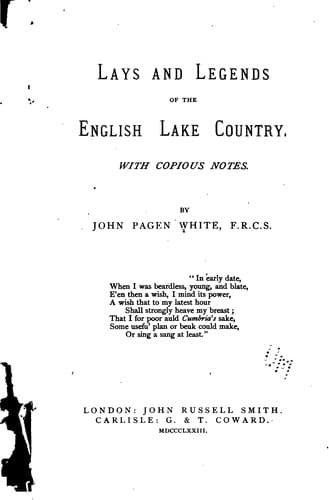
Lays and Legends of the English Lake Country: With Copious NotesWhite, John Pagen
General
Lays and Legends of the English Lake Country: With Copious Notes
White, John Pagen
Lake District (England) -- Poetry; Legends -- England -- Lake District
The Cistercian order in its origin was devoted to the practice
of penance, silence, assiduous contemplation, and the angelical
functions (as Mr. West expresses it) of singing the divine praises;
wherefore it did not admit of the ordinary dissipation which
attends scholastic enquiries. St. Bernard who was himself a man of
learning, well knowing how far reading was necessary to improve
the mind even of a recluse, took great care to furnish his monks
with good libraries. Such of them as were best qualified were
employed in taking copies of books in every branch of literature,
many of which, beautifully written on vellum, and elegantly
illuminated, are at this time to be seen in their libraries. They
used neither furs nor linen, and never eat any flesh, except in
time of dangerous sickness; they abstained even from eggs, butter,
milk, and cheese, unless upon extraordinary occasions, and when
given to them in alms. They had belonging to them certain religious
lay brethren, whose office was to cultivate their lands, and attend
to their secular affairs: these lived at their granges and farms,
and were treated in like manner with the monks, but were never
indulged with the use of wine. The monks who attended the choir
slept in their habits upon straw; they rose at midnight, and spent
the rest of the night in singing the divine office. After prime
and the first mass, having accused themselves of their faults in
public chapter, the rest of the day was spent in a variety of
spiritual exercises with uninterrupted silence. From the Feast of
the Exaltation of the Holy Cross (the 14th of September) until
Easter they observed a strict fast: and flesh was banished from
their infirmaries from Septuagesima until Easter. This latter
class of monks was confined to the boundary wall, except that on
some particular days the members of it were allowed to walk in
parties beyond it, for exercise and amusement; but they were very
seldom permitted either to receive or pay visits. Much of these
rigorous observances was mitigated by a bull of Pope Sixtus IV.,
in the year 1485, when among other indulgencies the whole order
was allowed to eat flesh three times in every week; for which
purpose a particular dining-room, separate and distinct from the
usual refectory, was fitted up in every monastery. They were
distinguished for extensive charities and liberal hospitality; for
travellers were so sumptuously entertained at the Abbey, that it
was not till the dissolution that an inn was thought necessary in
this part of Furness, when one was opened for their accommodation,
expressly because the Monastery could no longer receive them. With
the rules of St. Bernard the monks had adopted the white cassock,
with a white caul and scapulary. Their choral dress was either
Public-domain text, read in full here on John Shaqi.
Reviews
Reviews
No reviews yet
Be the first to share your thoughts on this work.
Elsewhere in the archive
Join the Discussion
Join the discussion
Sign in to leave a comment or review.
Sign InorCreate an account