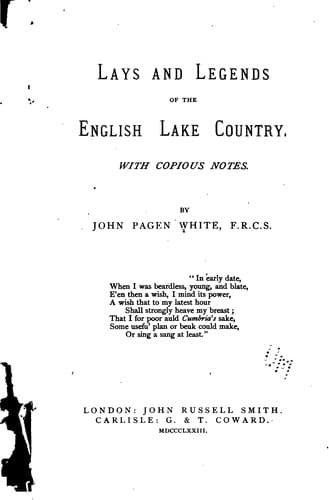
Lays and Legends of the English Lake Country: With Copious NotesWhite, John Pagen
General
Lays and Legends of the English Lake Country: With Copious Notes
White, John Pagen
Lake District (England) -- Poetry; Legends -- England -- Lake District
What wonder, says a lively writer, that Abbot Pele, or any other
man, owning such vast possessions and having such temporal and
spiritual privileges as the following, should have grown proud and
gross, and contumacious! Within the limits of his own district
he was little short of omnipotent. The same oath of fealty was
taken to him as to the king himself; he had no less than twelve
hundred and fifty-eight able men armed with coats of mail, spears,
and bows and arrows, upon the possessions of the Monastery, ready
for active service, four hundred of whom were cavalry; besides
manorial rights, he had extended feudal privileges, appointment of
sheriff, coroner, and constable, wreck of the sea, freedom from
suit of county; a free market and fair at Dalton, with a court of
criminal jurisdiction; lands and tenements exempt from all toll
and tax whatever; the emoluments incidental to wardship, such as
the fining of young ladies who married against his will, &c. He
had the patronage of all the churches save one; no bailiff could
come into his territories under any pretence whatever; and no man
was to presume in any way to molest or disturb him on pain of
forfeiting ten pounds to the king. In addition to its rich home
territory in the North Lonsdale, the Abbey possessed the manor
of Beaumont in the south; land and houses at Bolton, and in many
other places near Lancaster; five villages in Yorkshire, with much
land and pasturage; and a mansion for the abbot, in York itself;
all beautiful Borrowdale in Cumberland was their property; houses
at Boston in Lincolnshire; land in the Isle of Man; and houses
in Drogheda and two other towns in Ireland. The home lordship
comprehended the rich district of Low Furness and all the district
included between the river Duddon on the one side, and the Elter
(beginning at the Shire Stones on the top of Wrynose), Lake
Windermere and the Leven on the other; with the isles of Walney and
Foulney, and the Pile of Fouldrey. They had an excellent harbour
of refuge fitted to accommodate the largest vessels of that era at
any time of tide, and they had four good iron mines in their near
neighbourhood, the ore of which, however, they do not seem to have
exported. The total income of the society appears, at the time of
its dissolution in 1537, to have been more than nine hundred pounds
a-year; which would be represented by about ten times that value in
our time, or _nine thousand a-year_.
Public-domain text, read in full here on John Shaqi.
Reviews
Reviews
No reviews yet
Be the first to share your thoughts on this work.
Elsewhere in the archive
Join the Discussion
Join the discussion
Sign in to leave a comment or review.
Sign InorCreate an account