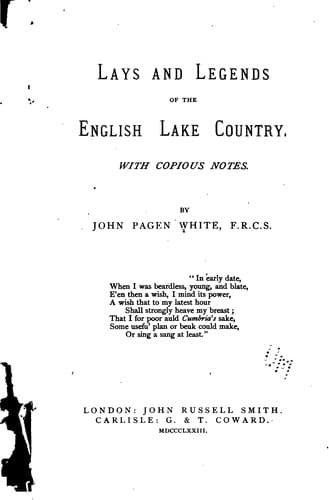
Lays and Legends of the English Lake Country: With Copious NotesWhite, John Pagen
General
Lays and Legends of the English Lake Country: With Copious Notes
White, John Pagen
Lake District (England) -- Poetry; Legends -- England -- Lake District
But in the reign of Edward the First, its revenues seem to have
been nearly as large again. According to the late Mr. Beck, the
author of _Annales Furnesienses_, to which we are indebted for much
of these particulars, the tenants of the Abbey paid great part of
their rents by provisioning the monks with grain, lambs, calves,
&c., or bartered them for beer, bread, iron, wood, and manure. More
than two hundred gallons of beer were distributed weekly among
these tenants upon tunning days, accompanied with about three score
of loaves of bread; the expenditure in this particular alone, per
annum, must have been at least one thousand pounds of our present
money: one ton of malleable iron was also given to the same people
for the repair of their ploughs, and wood for that of their houses
and fences. They might take, too, all the manure--amounting yearly
to four or five hundred cartloads--with the exception of that from
the Abbot's and high stables. The tenants paid by way of fine, or
admission to their tenements, but one penny, called "God's Penny,"
and were sworn to be true to the king and to the convent. What alms
were distributed amongst the poor by this wealthy and pious society
we have no means of discovering. It was bound, upon the anniversary
of Saints Crispin and Crispinian, to distribute two oxen, two cows,
and one bull among the poor folks who assembled for that purpose
at the Porter's Lodge. At the same place, ninety-nine shillings'
worth of bread, and six maze of _fresh_ herrings, valued at forty
shillings, were also given in alms every Monday and Tuesday; the
convent maintained from its very commencement thirteen poor men,
allowing each of them thirty-three shillings and fourpence yearly:
and eight widows received a similar allowance of provisions to that
allowed for the same number of monks. They had five flagons of ale
weekly, and each of them a _clibanus_,[15] which it is supposed
must have been a certain quantity of bread. Lastly, there were two
schools held in some part of the monastery, where the children
of those tenants who paid their rent in provisions, and who it
is probable lived in the neighbourhood, received their education
gratuitously, and dined in the hall during their attendance as
well. If one of these showed symptoms of superior intelligence, he
had the privilege of being elected into the society in preference
to all others, by which step he might rise by good fortune or
_finesse_ even to be Lord of Furness.
Public-domain text, read in full here on John Shaqi.
Reviews
Reviews
No reviews yet
Be the first to share your thoughts on this work.
Elsewhere in the archive
Join the Discussion
Join the discussion
Sign in to leave a comment or review.
Sign InorCreate an account