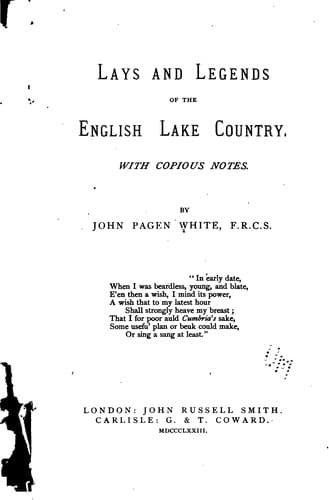
Lays and Legends of the English Lake Country: With Copious NotesWhite, John Pagen
General
Lays and Legends of the English Lake Country: With Copious Notes
White, John Pagen
Lake District (England) -- Poetry; Legends -- England -- Lake District
The vigour of Gregory king of Scotland having been found,
notwithstanding his prowess and the success of his arms, inadequate
to support an authority which had been usurped by him as regent
during the minority of Eocha, after holding the reins of government
in Scotland and Strathclyde during eleven years, was expelled,
together with Eocha, by Donal, son of the late King Constantine
II., A. D. 893.
To Donal, who was slain by the Danes, A. D. 904, succeeded his
cousin Constantine III., the son of Aodh, who had been slain by
Gregory. Another Donal, brother to Constantine III., had been
"elected" king of the Strathclyde Britons four years before the
elevation of that monarch to the throne of Scotland. During the
life of this Donal, the districts of Carlisle and Galloway were
not united to Strathclyde, but remained attached to Scotland; from
which, however, they were separated after his decease, and given to
his son and successor, Eugenius.
To the new kingdom, thus founded by Constantine in favour of his
nephew and presumptive heir, by the union of Carlisle and Galloway
with Strathclyde, was given the name of Cumbria, derived from the
common appellation of its inhabitants. Its extent is precisely
defined in a return made by the prior and convent of Carlisle
to a writ of Edward the First, requiring them, as well as other
religious houses, to furnish, from chronicles or other documents
in their possession, any information bearing upon the alleged
right of supremacy over Scotland vested in the English crown. The
return sets forth, "That district was called Cumbria, which is now
included in the bishoprics of Carlisle, Glasgow, and Whitherne,
together with the country lying between Carlisle and the river
Duddon:" in other words, the entire tract from the Clyde to the
confines of Lancashire. In the "Inquisitio Davidis," which does
indeed extend to all parts of Cumbria which remained in David's
possession, we are expressly told that "he had not then within
his dominion the whole Cumbrian region," the present county of
Cumberland, or, as it was then called, Earldom of Carlisle, having
been severed from it soon after the Norman Conquest. Although
Fordun is the only author who narrates the cession of Carlisle and
Galloway to Gregory, and the subsequent grant of these districts
to Eugenius, whereby they were united to Strathclyde, and the
whole merged into a single government, we have abundant evidence
of the existence of Cumbria and the intimate union of Constantine
and Eugenius at this period. In the year 938, these princes, in
conjunction with the Danes and Welsh, attempted to wrest the
sovereign power out of the vigorous hands of Athelstane. The
combined forces were signally defeated by the Anglo-Saxon monarch
at Brunanburgh (supposed by some to be Bromborough, near Chester);
Public-domain text, read in full here on John Shaqi.
Reviews
Reviews
No reviews yet
Be the first to share your thoughts on this work.
Elsewhere in the archive
Join the Discussion
Join the discussion
Sign in to leave a comment or review.
Sign InorCreate an account