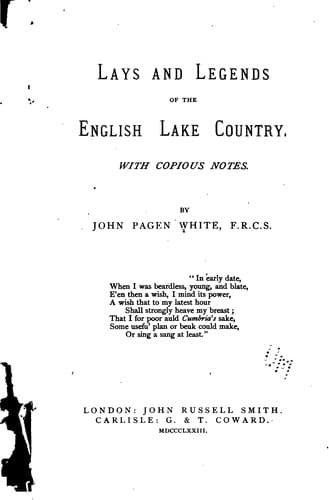
Lays and Legends of the English Lake Country: With Copious Notes — John Shaqi
Lays and Legends of the English Lake Country: With Copious NotesWhite, John Pagen
General
Lays and Legends of the English Lake Country: With Copious Notes
White, John Pagen
Lake District (England) -- Poetry; Legends -- England -- Lake District
The little rocky tree-decked islet in Windermere, called St.
Mary's, or the Ladye's Holme, hitherto reputed to have formed part
of the conventual domains of the Abbey at Furness, had its name
from a chantry dedicated to the Virgin Mary, which was standing
up to the reign of King Henry the Eighth, but of which no traces
are now remaining. "When," says an anonymous writer, "at the
Reformation, that day of desolation came, which saw the attendant
priests driven forth, and silenced for ever the sweet chant of
orison and litany within its walls; the isle and revenues of the
institution were sold to the Philipsons of Calgarth. By them the
building was suffered to fall into so utter a state of ruin,
that no trace even of its foundations is left to proclaim to the
stranger who meditates upon the fleeting change of time and creed,
that here, for more than three centuries, stood a hallowed fane,
from whence at eventide and prime prayers were wafted through the
dewy air, where now are only heard the festal sounds of life's
more jocund hours." Lately renewed antiquarian investigation has,
however, disclosed the erroneousness of the generally received
statement respecting the early ownership of this tiny spot; as in
Dodsworth's celebrated collection of ancient evidences there is
contained an Inquisition, or the copy of one, taken at Kendal, so
far back as the Monday after the feast of the Annunciation, in
the 28th Edward the Third, which shews that this retreat, amid
the waters of our English Como, appertained not to Furness Abbey,
but to the house of Segden, in Scotland, which was bound always
to provide two resident chaplains for the service of our Ladye's
Chapel in this island solitude. For the maintenance and support of
those priests, certain lands were given by the founder, who was
either one of that chivalrous race, descended from the Scottish
Lyndseys "light and gay," whose immediate ancestor in the early
part of the thirteenth century had married Alice, second daughter
and co-heiress of William de Lancaster, eighth Lord of Kendal;
and with her obtained that moiety of the Barony of Kendal, whose
numerous manors are collectively known as the Richmond Fee; or the
chantry may have owed its foundation to the pious impulses of
Ingelram de Guignes, Sire de Courci, one of the grand old Peers of
France, whose house, so renowned in history and romance, proclaimed
its independence and its pride in this haughty motto:--
"Je ne suis Roy ni Prince aussi,
Je suis Le Seignhor de Courci."
And which Ingelram in 1285 married Christiana, heiress of the last
de Lyndsey, and in her right, besides figuring on innumerable
occasions as a feudal potentate, both in England and Scotland, he
became Lord of the Fee, within which lies St. Mary's Isle.
Public-domain text, read in full here on John Shaqi.
Reviews
Reviews
No reviews yet
Be the first to share your thoughts on this work.
Join the Discussion
Join the discussion
Sign in to leave a comment or review.
Sign InorCreate an account