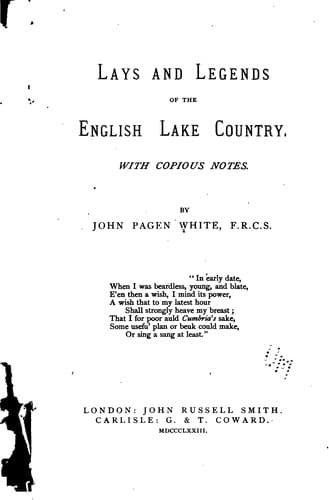
Lays and Legends of the English Lake Country: With Copious Notes — John Shaqi
Lays and Legends of the English Lake Country: With Copious NotesWhite, John Pagen
General
Lays and Legends of the English Lake Country: With Copious Notes
White, John Pagen
Lake District (England) -- Poetry; Legends -- England -- Lake District
On an Inquisition taken after the death of Johanna de Coupland,
in the 49th Edward the Third, it was found that she held the
advowson of the Chapel of Saint Mary's Holme, within the lake of
Wynandermere, but that it was worth nothing, because the land
which the said Chapel enjoyed of old time had been seized into
the hands of the King, and lay within the park of Calgarth. It is
on record, however, that in 1492, an annual sum of six pounds was
paid out of the revenues of the Richmond Fee, towards the support
of the Chaplains; and in the returns made by the ecclesiastical
Commissioners in Edward the Sixth's reign, "the free Chapel of
Holme and Wynandermere" is mentioned, shortly after which it was
granted, as aforesaid, to the owners of Calgarth.
The singular name of the "Crier of Claife" is now applied to an
extensive slate or flag quarry, long disused, and overgrown with
wood, on the wildest and most lonely part of the height called
Latter-barrow, which divides the vales of Esthwaite and Windermere,
above the Ferry. In this desolate spot, by the sanctity and skill
of holy men, had been exorcised and laid the apparition who had
come to be known throughout the country by that title; and the
place itself has ever since borne the same name. None of the
country people will go near it after night fall, and few care to
approach it even in daylight. Desperate men driven from their homes
by domestic discord, have been seen going in its direction, and
never known to return. It is said the Crier is allowed to emerge
occasionally from his lonely prison, and is still heard on very
stormy nights sending his wild entreaty for a boat, howling across
Windermere. Mr. Craig Gibson, in one of his graphic sketches of
the Lake country, says that he is qualified to speak to this, for
he himself has heard him. "At least," says he, "I have heard what
I was solemnly assured by an old lady at Cunsey must have been
the Crier of Claife. Riding down the woods a little south of the
Ferry, on a wild January evening, I was strongly impressed by a
sound made by the wind as, after gathering behind the hill called
Gummershow for short periods of comparative calm, it came rushing
up and across the lake with a sound startlingly suggestive of
the cry of a human being in extremity, wailing for succour. This
sound lasted till the squall it always preceded struck the western
shore, when it was lost in the louder rush of the wind through the
leafless woods. I am induced to relate this," he continues, "by
the belief I entertain that the phenomenon described thus briefly
and imperfectly, may account for much of the legend, and that the
origin of many similar traditional superstitions may be found in
something equally simple."
Public-domain text, read in full here on John Shaqi.
Reviews
Reviews
No reviews yet
Be the first to share your thoughts on this work.
Join the Discussion
Join the discussion
Sign in to leave a comment or review.
Sign InorCreate an account