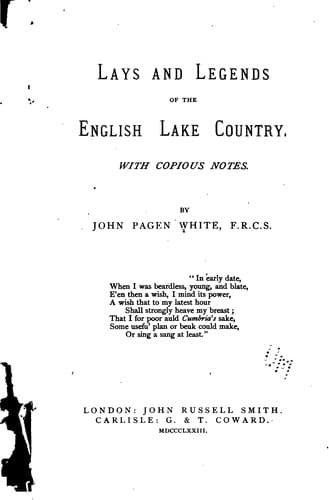
Lays and Legends of the English Lake Country: With Copious NotesWhite, John Pagen
General
Lays and Legends of the English Lake Country: With Copious Notes
White, John Pagen
Lake District (England) -- Poetry; Legends -- England -- Lake District
Eugenius was slain, and Constantine escaped only by a precipitate
retreat.
It is at this period that Dunmail, the second and last _sole_
"king of rocky Cumberland," appears upon the historic stage. It
has been thought not improbable that he was the son of Eugenius or
Owen, the preceding king, and the same person who is described as
Dunwallon, "the son of Owen," and who died at Rome thirty years
after his memorable engagement with Edmund of England and Leoline
of South Wales, in the mountain pass which is distinguished by
his name. "In the annals of Ulster, indeed," say the supporters
of this supposition, "this Dunwallon is described as king of
Wales, but Caradoc calls him prince of Strathclyde, and his
patronymic designation seems to identify him with Dunmail, if, as
we assume, the latter was the son of the first king of Cumberland."
But by whatever means Dunmail obtained the crown; whether by
inheritance as the son of Eugenius, or by "election" as one of
the native Cumbrian princes, and according to the ancient custom
of the Britons; we soon find him supporting the Northumbrians in
hostilities against the Saxon monarch, Edmund the First. That
monarch, although victorious, was so weakened that he dared not
pursue Dunmail without the assistance of the Scots. And the
condition upon which Malcolm, king of Scotland, joined Edmund with
his forces, was, that if they were successful, Malcolm should
possess Cumbria by paying homage to Edmund and his successors. The
subjection of this wild race of mountaineers was then determined
upon as a necessary step towards the pacification of the kingdom;
and the last record which history affords us of the Cumbrian
Britons, is that of their defeat, A. D. 945, in the heart of their
native mountains, between Grasmere and Keswick, and their final
dispersion or emigration into Wales.
Public-domain text, read in full here on John Shaqi.
Reviews
Reviews
No reviews yet
Be the first to share your thoughts on this work.
Elsewhere in the archive
Join the Discussion
Join the discussion
Sign in to leave a comment or review.
Sign InorCreate an account