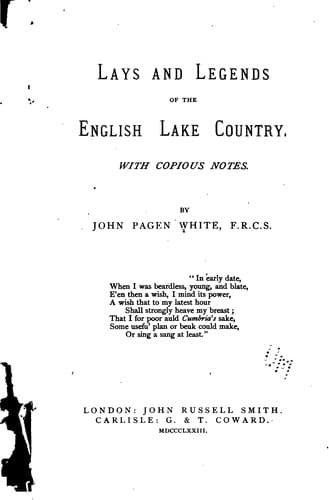
Lays and Legends of the English Lake Country: With Copious NotesWhite, John Pagen
General
Lays and Legends of the English Lake Country: With Copious Notes
White, John Pagen
Lake District (England) -- Poetry; Legends -- England -- Lake District
The place where Dunmail determined to hazard the battle which
proved fatal to him was the famous Pass which bears his name.
Edmund slew his vanquished enemy upon the spot which is still
commemorated by the rude pile of stones so well known as his
cairn; and, in conformity with the barbarous customs of that age,
put out the eyes of his two sons; after which, having completely
ravaged and laid waste the territories of Dunmail, he bestowed
them on his ally Malcolm; the latter undertaking to preserve in
peace the Northern parts of England, and to pay the required
fealty and homage to Edmund. Upon the same conditions they were
afterwards confirmed to him by one of Edmund's successors, Edgar;
which monarch also divided what at that time remained of the
ancient kingdom of Northumbria into Baronies, and constituted it an
Earldom. Thenceforward these north western regions were held as a
military benefice subject to the English sceptre by the heir to the
crown of Scotland, under the title of the Principality of Cymriland
or Cumbria. This Principality, which included Westmorland,
continued in possession of the heirs to the Scottish crown during
the reigns of Harold and Hardicanute, the last Danish Kings, and of
Edward the Confessor and Harold the Second, the last Saxon monarchs
of England.
The only circumstance which is recorded of it during the century
which followed the defeat of Dunmail, is its total devastation
by Ethelred, king of England, A. D. 1000, at which time it is
represented by Henry of Huntingdon as the principal rendezvous of
the marauding Danes.
In the year 1052, Macbeth held the Scottish throne, whilst Malcolm,
the son of his predecessor, the murdered Duncan, sat on that of
Cumbria. Siward, earl of Northumberland, was commissioned by
Edward the Confessor to invade Scotland, and avenge the "murder"
of Duncan. In this he succeeded, defeated and slew Macbeth, and
placed the king of Cumbria, or, as some historians assert, his son,
on the throne of Scotland. This Malcolm, surnamed Canmore, held at
the time of the Conquest, Cumbria and Lothian, in addition to the
ancient kingdom of Scotland.
In the year 1072, the Earldom of Carlisle, containing the present
County of Cumberland, with the Barony of Westmorland, was wrested
from Malcolm Canmore by William the Conqueror, who granted it
to his powerful noble, Ranulph de Meschin, one of that numerous
train of military adventurers, amongst whom he had distributed
all the fair territory of Britain, to hold, with a sort of royal
power, by the sword, as he himself held the kingdom by virtue of
the crown,--_tenere ita libere ad gladium, sicut ipse rex tenebat
Angliam per coronam_.
Public-domain text, read in full here on John Shaqi.
Reviews
Reviews
No reviews yet
Be the first to share your thoughts on this work.
Elsewhere in the archive
Join the Discussion
Join the discussion
Sign in to leave a comment or review.
Sign InorCreate an account