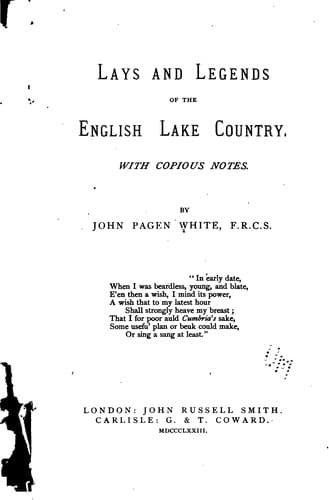
Lays and Legends of the English Lake Country: With Copious NotesWhite, John Pagen
General
Lays and Legends of the English Lake Country: With Copious Notes
White, John Pagen
Lake District (England) -- Poetry; Legends -- England -- Lake District
Thus the existing limits were established between England and
Scotland. The kingdom of Cumbria was reduced to the dimensions
indicated by the "Inquisitio Davidis," and was held as a
principality dependent on the crown of Scotland; until it at length
became formally attached to the Scottish dominions.
Meanwhile the Barony of Westmorland having been separated from the
Earldom of Carlisle, there remained the district comprised within
the present limits of the County of Cumberland, to which alone that
name was thenceforward applied.
The circular heap of stones which forms the pile called
Dunmail-Raise, and gives its name to the mountain Pass between the
vales of Grasmere and Wytheburn, is seen adjoining the highroad,
where it is crossed by the wall which there marks the boundaries
of Westmorland and Cumberland. The stones constituting this rude
monument are thrown loosely together on each side of an earthen
mound in a huge cairn or _raise_, the history of which is little
known, and concerning which antiquarians are by no means agreed.
It measures twenty-four yards in diameter, and rises gradually to
an elevation of six feet, being flat at the top, and the centre
indicated by a well defined space in rather larger stones.
Mr. Gilpin conjectures that the pile was probably intended to
mark a division not between the two Counties of Cumberland and
Westmorland, but rather between the two kingdoms of England and
Scotland, in elder times, when the Scottish border extended beyond
its present bounds. The generally received tradition, however,
concerning this cairn is, that it was raised to commemorate the
name and defeat of Dunmail, the last king of Cumbria, in the year
945, in his conflict with the Saxon Edmund, on the occasion above
related. "But," says Mr. Gilpin, "for whatever purpose this rude
pile was fabricated, it hath yet suffered little change in its
dimensions; and is one of those monuments of antiquity, which may
be characterized by the scriptural phrase of _remaining to this
very day_."
Public-domain text, read in full here on John Shaqi.
Reviews
Reviews
No reviews yet
Be the first to share your thoughts on this work.
Elsewhere in the archive
Join the Discussion
Join the discussion
Sign in to leave a comment or review.
Sign InorCreate an account