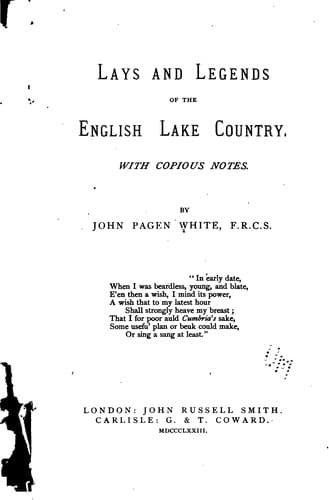
Lays and Legends of the English Lake Country: With Copious Notes — John Shaqi
Lays and Legends of the English Lake Country: With Copious NotesWhite, John Pagen
General
Lays and Legends of the English Lake Country: With Copious Notes
White, John Pagen
Lake District (England) -- Poetry; Legends -- England -- Lake District
The late Mr. John Briggs, in his notes upon "Westmorland as it
was," by the Rev. Mr. Hodgson, has furnished his readers with some
curious information upon the "philosophy of spirits," which he
collected from those ancient sages of the dales who were supposed
to be best acquainted with the subject. Many of these superstitions
are now exploded: but the marvellous tales at one time currently
believed, still furnish conversation for the cottage fireside.
According to the gravest authorities, he says, no spirit could
appear before twilight had vanished in the evening, or after it
had appeared in the morning. On this account, the winter nights
were peculiarly dangerous, owing to the long revels which ghosts,
or dobbies, as they were called, could keep at that season. There
was one exception to this. If a man had murdered a woman who was
with child by him, she had power to haunt him at all hours; and the
Romish priests (who alone had the power of laying spirits,) could
not lay a spirit of this kind with any certainty, as she generally
contrived to break loose long before her stipulated time. A culprit
might hope to escape the gallows, but there was no hope of escaping
being haunted. In common cases, however, the priest could "lay"
the ghosts; "while ivy was green," was the usual term. But in
very desperate cases, they were laid in the "Red Sea," which was
accomplished with great difficulty and even danger to the exorcist.
In this country, the most usual place to confine spirits was under
Haws Bridge, a few miles below Kendal. Many a grim ghost has been
chained in that dismal trough!
According to the laws to which they were subject, ghosts could
seldom appear to more than one person at a time. When they appeared
to the eyes, they had not the power of making a noise; and when
they saluted the ear, they could not greet the eyes. To this,
however, there was an exception, when a human being spoke to them
in the name of the Blessed Trinity. For it was an acknowledged
truth, that however wicked the individual might have been in this
world, or however light he might have made of the Almighty's name,
he would tremble at its very sound, when separated from his earthly
covering.
Public-domain text, read in full here on John Shaqi.
Reviews
Reviews
No reviews yet
Be the first to share your thoughts on this work.
Join the Discussion
Join the discussion
Sign in to leave a comment or review.
Sign InorCreate an account