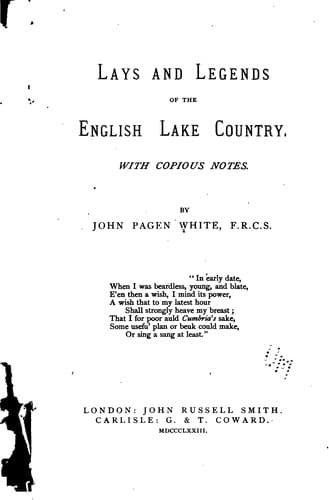
Lays and Legends of the English Lake Country: With Copious NotesWhite, John Pagen
General
Lays and Legends of the English Lake Country: With Copious Notes
White, John Pagen
Lake District (England) -- Poetry; Legends -- England -- Lake District
A genuine specimen of feudal observances is preserved in the
custom of riding the boundaries of manors, which, in the mountain
district, where the line of division is not very distinct,
is performed perhaps once during each generation, by the
representatives of the lord of the manor, accompanied by an immense
straggling procession of all ages,--the old men being made useful
in pointing out important or disputed portions of the boundary,
and the young in having it impressed on their memories, so that
their evidence or recollection may be made available in future
peregrinations. In older times, when the interests of the lords
outweighed farther than in our own day the rights of the peasantry,
certain youthful members of the retinue, in order to deepen the
impression and make it more enduring, were severely whipped at all
those points which the stewards were most anxious to have held in
remembrance. The occasions always wind up with a banquet, provided
on a most liberal scale by the lord of the manor, and open to all
who take part in the business of the day.
Another local usage connected with the landed interest, and long
observed with notable regularity, was the following. When salmon
was plentiful in the Cumberland rivers, and formed a very important
element in the ordinary living of the occupants of adjoining lands,
the tenants of the manor of Ennerdale and Kinniside claimed "a
free stream" in the river Ehen, from Ennerdale lake to the sea,
and assembled once a year to "ride the stream." If obstructions
were found, such as weirs and dams, they were at once destroyed.
Refreshments were levied or provided at certain places on the river
for the cavalcade. This custom has long ceased to be observed.
About a quarter of a mile to the south east of this place is
an old ivy-mantled ruin, designated Wall Castle. It is said to
have been the original residence of the Penningtons, but in all
probability it dates from a much remoter period. Stone battle-axes
and arrow-heads have been found around it, and coins of different
people, principally Roman and Saxon. The building is strongly
cemented with run lime.
Public-domain text, read in full here on John Shaqi.
Reviews
Reviews
No reviews yet
Be the first to share your thoughts on this work.
Join the Discussion
Join the discussion
Sign in to leave a comment or review.
Sign InorCreate an account