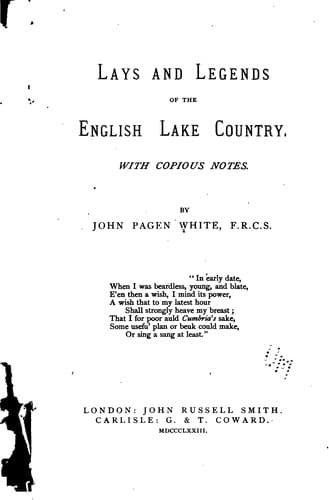
Lays and Legends of the English Lake Country: With Copious NotesWhite, John Pagen
General
Lays and Legends of the English Lake Country: With Copious Notes
White, John Pagen
Lake District (England) -- Poetry; Legends -- England -- Lake District
This old castle stands at no great distance from the second cutting
through which the railroad passes after leaving Ravenglass:
adjoining to which, a little below the surface of the ground, an
ancient fosse and several foundations of walls have been laid
bare by the owner of the estate, and large quantities of building
stone removed from them at various times. In making this cutting,
the workmen laid open an ancient burial place, which was of great
depth, and contained a quantity of human remains, with several
bones of animals. The sides were secured by strong timber and
stone work. The buried bodies were very numerous, and the place
was evidently of very great antiquity. From the presence of oak
leaves and acorns, charred wood, etc., it has been supposed to have
been the tomb of the victims in some Druidical sacrifice: it being
known that the Druids immolated their criminals, by placing them
collectively in the interior of a large image of wickerwork, and
then setting fire to it; and that various animals were sacrificed
along with them by way of expiation.
About five miles to the east of Ravenglass is the small lake
of Devoke Water, near the foot of which, on the summit of a
considerable hill, stand the ruins of another interesting piece of
antiquity, the so-called city of Barnscar or Bardscar. Its site is
so elevated, as to command a wide extent of country, and an ancient
road from Ulpha to Ravenglass passes through it. The name is purely
Scandinavian, and tradition ascribes it to the Danes. A well known
popular saying in the locality refers to the manner in which this
city is said to have been peopled by its founders, who gathered
for inhabitants the men of Drigg and the women of Beckermet. The
original helpmates of the latter place are supposed to have fallen
in battle: what had become of the wives and daughters of the former
place is not averred. But the saying continues--"Let us gang
togidder like t' lads o' Drigg, an' t' lasses o' Beckermet."
Public-domain text, read in full here on John Shaqi.
Reviews
Reviews
No reviews yet
Be the first to share your thoughts on this work.
Join the Discussion
Join the discussion
Sign in to leave a comment or review.
Sign InorCreate an account