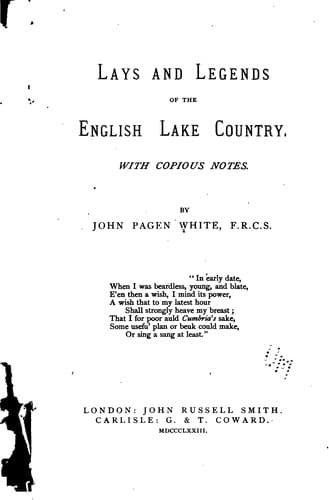
Lays and Legends of the English Lake Country: With Copious Notes — John Shaqi
Lays and Legends of the English Lake Country: With Copious NotesWhite, John Pagen
General
Lays and Legends of the English Lake Country: With Copious Notes
White, John Pagen
Lake District (England) -- Poetry; Legends -- England -- Lake District
John, his son, the next and ninth lord, called from his complexion
the Black-faced Clifford, thirsting to revenge the fate of his
father, perpetrated that memorable act of cruelty, which for
centuries has excited indignation and tears, the murder of the
young Earl of Rutland, brother of Edward IV., in the pursuit after
the battle of Wakefield, on the 30th December, 1460. The latter,
whilst being withdrawn from the field by his attendant chaplain
and schoolmaster, a priest, called Sir Robert Aspall, was espied
by Lord Clifford; and being recognised by means of his apparel,
"dismayed, had not a word to speak, but kneeled on his knees
imploring mercy and desiring grace, both with holding up his hands
and making dolorous countenance, for his speech was gone for fear.
'Save him,' said his chaplain, 'for he is a prince's son, and
peradventure may do you good hereafter.' With that word, the Lord
Clifford marked him and said, 'By God's blood, thy father slew
mine, and so will I do thee and all thy kin;' and with that word
stuck the earl to the heart with his dagger, and bade his chaplain
bear the earl's mother and brother word what he had done and said."
The murder in cold blood of this unarmed boy, for he was only
twelve or at most seventeen years old, while supplicating for his
life, was not the only atrocity committed by Lord Clifford on
that eventful day. "This cruel Clifford and deadly blood-supper,"
writes the old chronicler, "not content with this homicide or
child-killing, came to the place where the dead corpse of the Duke
of York lay, and caused his head to be stricken off, and set on it
a crown of paper, and so fixed it on a pole and presented it to
the queen, not lying far from the field, in great spite and much
derision, saying, 'Madam, your war is done; here is your king's
ransom;' at which present was much joy and great rejoicing."
Lord Clifford fought at the second battle of St. Albans, on the
17th of February, 1461. It was in his tent, after the Lancastrians
had won the victory, that the unfortunate Henry VI. once more
embraced his consort Margaret of Anjou, and their beloved child.
Lord Clifford is usually represented as having been slain at the
battle of Towton. He fell, however, in a hard fought conflict
which preceded that engagement by a few hours, at a spot called
Dittingale, situated in a small valley between Towton and
Scarthingwell, struck in the throat by a headless arrow, discharged
from behind a hedge.
A small chapel on the banks of the Aire formerly marked the spot
where lay the remains of John Lord Clifford, as well as those of
his cousin, Henry Percy, Earl of Northumberland, who perished later
in the day upon Towton Field, on the 29th of March, 1461.
Public-domain text, read in full here on John Shaqi.
Reviews
Reviews
No reviews yet
Be the first to share your thoughts on this work.
Join the Discussion
Join the discussion
Sign in to leave a comment or review.
Sign InorCreate an account