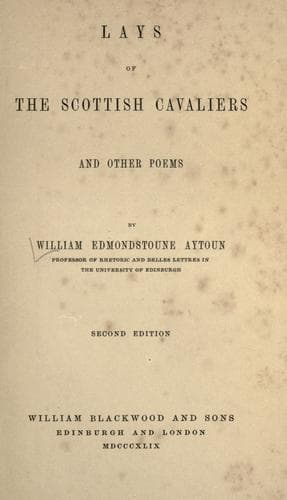
Lays of the Scottish Cavaliers and Other PoemsAytoun, William Edmondstoune
History
Lays of the Scottish Cavaliers and Other Poems
Aytoun, William Edmondstoune
Scotland -- History -- Poetry
"It is owned," says Abercromby, "that both parties did wonders, but none
on either side performed more than the King himself. He was again told
that by coming to handy blows he could do no more than another man,
whereas, by keeping the post due to his station, he might be worth many
thousands. Yet he would not only fight in person, but also on foot; for
he no sooner saw that body of the English give way which was defeated by
the Earl of Huntley, but he alighted from his horse, and commanded his
guard of noblemen and gentlemen to do the like and follow him. He had at
first abundance of success; but at length the Lord Thomas Howard and Sir
Edward Stanley, who had defeated their opposites, coming in with the
Lord Dacre's horse, and surrounding the King's battalion on all sides,
the Scots were so distressed that, for their last defence, they cast
themselves into a ring; and being resolved to die nobly with their
sovereign, who scorned to ask quarter, were altogether cut off. So say
the English writers, and I am apt to believe that they are in the
right."
The battle was maintained with desperate fury until nightfall. At the
close, according to Mr. Tytler, "Surrey was uncertain of the result of
the battle: the remains of the enemy's centre still held the field;
Home, with his Borderers, still hovered on the left; and the commander
wisely allowed neither pursuit nor plunder, but drew off his men, and
kept a strict watch during the night. When the morning broke, the
Scottish artillery were seen standing deserted on the side of the hill;
their defenders had disappeared; and the Earl ordered thanks to be given
for a victory which was no longer doubtful. Yet, even after all this, a
body of the Scots appeared unbroken upon a hill, and were about to
charge the Lord-Admiral, when they were compelled to leave their
position by a discharge of the English ordnance.
"The loss of the Scots in this fatal battle amounted to about ten
thousand men. Of these, a great proportion were of high rank; the
remainder being composed of the gentry, the farmers, and landed
yeomanry, who disdained to fly when their sovereign and his nobles lay
stretched in heaps around them." Besides King James, there fell at
Flodden the Archbishop of St. Andrew's, thirteen earls, two bishops, two
abbots, fifteen lords and chiefs of clans, and five peers' eldest sons,
besides La Motte the French ambassador, and the secretary of the King.
The same historian adds--"The names of the gentry who fell are too
numerous for recapitulation, since there were few families of note in
Scotland which did not lose one relative or another, whilst some houses
had to weep the death of all. It is from this cause that the sensations
of sorrow and national lamentation occasioned by the defeat were
peculiarly poignant and lasting--so that to this day few Scotsmen can
hear the name of Flodden without a shudder of gloomy regret."
Public-domain text, read in full here on John Shaqi.
Reviews
Reviews
No reviews yet
Be the first to share your thoughts on this work.
Join the Discussion
Join the discussion
Sign in to leave a comment or review.
Sign InorCreate an account