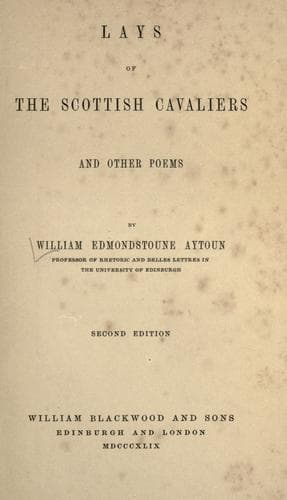
Lays of the Scottish Cavaliers and Other PoemsAytoun, William Edmondstoune
History
Lays of the Scottish Cavaliers and Other Poems
Aytoun, William Edmondstoune
Scotland -- History -- Poetry
The loss to Edinburgh on this occasion was peculiarly great. All the
magistrates and able-bodied citizens had followed their King to Flodden,
whence very few of them returned. The office of Provost or chief
magistrate of the capital was at that time an object of ambition, and
was conferred only upon persons of high rank and station. There seems to
be some uncertainty whether the holder of this dignity at the time of
the battle of Flodden was Sir Alexander Lauder, ancestor of the
Fountainhall family, who was elected in 1511, or that great historical
personage, Archibald Earl of Angus, better known as Archibald
Bell-the-Cat, who was chosen in 1513, the year of the battle. Both of
them were at Flodden. The name of Sir Alexander Lauder appears upon the
list of the slain; Angus was one of the survivors, but his son, George,
Master of Angus, fell fighting gallantly by the side of King James. The
city records of Edinburgh, which commence about this period, are not
clear upon the point, and I am rather inclined to think that the Earl of
Angus was elected to supply the place of Lauder. But although the actual
magistrates were absent, they had formally nominated deputies in their
stead. I find, on referring to the city records, that "George of Tours"
had been appointed to officiate in the absence of the Provost, and that
four other persons were selected to discharge the office of bailies
until the magistrates should return.
It is impossible to describe the consternation which pervaded the whole
of Scotland when the intelligence of the defeat became known. In
Edinburgh it was excessive. Mr. Arnot, in the history of that city,
says,--
"The news of their overthrow in the field of Flodden reached Edinburgh
on the day after the battle, and overwhelmed the inhabitants with grief
and confusion. The streets were crowded with women seeking intelligence
about their friends, clamouring and weeping. Those who officiated in
absence of the magistrates proved themselves worthy of the trust. They
issued a proclamation, ordering all the inhabitants to assemble in
military array for defence of the city, on the tolling of the bell; and
commanding, 'that all women, and especially strangers, do repair to
their work, and not be seen upon the street _clamorand and cryand_; and
that women of the better sort do repair to the church and offer up
prayers, at the stated hours, for our Sovereign Lord and his army, and
the townsmen who are with the army.'"
Public-domain text, read in full here on John Shaqi.
Reviews
Reviews
No reviews yet
Be the first to share your thoughts on this work.
Join the Discussion
Join the discussion
Sign in to leave a comment or review.
Sign InorCreate an account