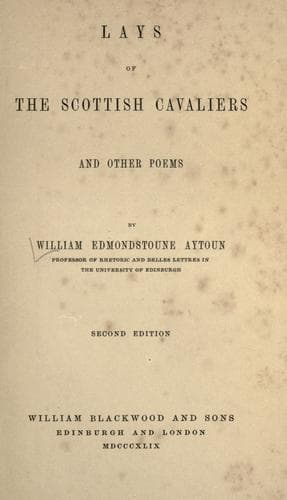
Lays of the Scottish Cavaliers and Other Poems — John Shaqi
Lays of the Scottish Cavaliers and Other PoemsAytoun, William Edmondstoune
History
Lays of the Scottish Cavaliers and Other Poems
Aytoun, William Edmondstoune
Scotland -- History -- Poetry
When we look at the portrait of Claverhouse, and survey the calm,
melancholy, and beautiful features of the devoted soldier, it appears
almost incredible that he should ever have suffered under such an
overwhelming load of misrepresentation. But when--discarding modern
historians, who in too many instances do not seem to entertain the
slightest scruple in dealing with the memory of the dead--we turn to the
writings of his contemporaries who knew the man, his character appears
in a very different light. They describe him as one who was stainless in
his honour, pure in his faith, wise in council, resolute in action, and
utterly free from that selfishness which disgraced the Scottish
statesmen of the time. No one dares question his loyalty, for he sealed
that confession with his blood; and it is universally admitted, that
with him fell the last hopes of the reinstatement of the house of
Stuart.
I may perhaps be permitted here, in the absence of a better chronicler,
to mention a few particulars of his life, which, I believe, are
comparatively unknown. John Graham of Claverhouse was a cadet of the
family of Fintrie, connected by intermarriage with the blood-royal of
Scotland. After completing his studies at the University of St.
Andrew's, he entered, as was the national custom for gentlemen of good
birth and limited means, into foreign service, served some time in
France as a volunteer, and afterwards went to Holland. He very soon
received a commission, as a cornet in a regiment of horse-guards, from
the Prince of Orange, nephew of Charles II. and James VII., and who
afterwards married the Princess Mary. His manner at that time is thus
described:--"He was then ane esquire, under the title of John Graham of
Claverhouse; but the vivacity of his parts, and the delicacy and justice
of his understanding and judgment, joyned with a certain vigour of mind
and activity of body, distinguished him in such a manner from all others
of his rank, that though he lived in a superior character, yet he
acquired the love and esteem of all his equals, as well as of those who
had the advantage of him in dignity and estate."
By one of those singular accidents which we occasionally meet with in
history, Graham, afterwards destined to become his most formidable
opponent, saved the life of the Prince of Orange at the battle of St.
Neff. The Prince's horse had been killed, and he himself was in the
grasp of the enemy, when the young cornet rode to his rescue, freed him
from his assailants, and mounted him on his own steed. For this service
he received a captain's commission, and the promise of the first
regiment that should fall vacant.
Public-domain text, read in full here on John Shaqi.
Reviews
Reviews
No reviews yet
Be the first to share your thoughts on this work.
Join the Discussion
Join the discussion
Sign in to leave a comment or review.
Sign InorCreate an account