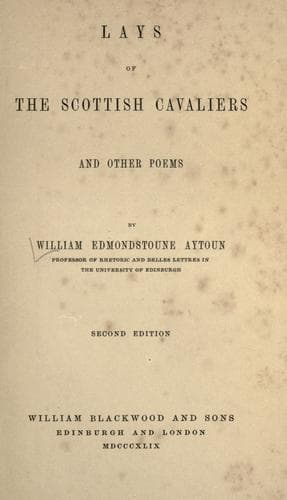
Lays of the Scottish Cavaliers and Other PoemsAytoun, William Edmondstoune
History
Lays of the Scottish Cavaliers and Other Poems
Aytoun, William Edmondstoune
Scotland -- History -- Poetry
But even in early life William of Orange was not famous for keeping his
promises. Some years afterwards, a vacancy in one of the Scottish
regiments in the Prince's service occurred, and Claverhouse, relying
upon the previous assurance, preferred his claim. It was disregarded,
and Mr. Collier, afterwards Earl of Portmore, was appointed over his
head. It would seem that Graham had suspected some foul play on the
part of this gentleman, for, shortly after, they accidentally met and
had an angry altercation. This circumstance having come to the ears of
the Prince, he sent for Captain Graham, and administered a sharp rebuke.
I give the remainder of this incident in the words of the old writer,
because it must be considered a very remarkable one, as illustrating the
fiery spirit and dauntless independence of Claverhouse.
"The Captain answered, that he was indeed in the wrong, since it was
more his Highness's business to have resented that quarrel than his;
because Mr. Collier had less injured him in disappointing him of the
regiment, than he had done his Highness in making him break his word.
'Then,' replied the Prince in an angry tone, 'I make you full
reparation, for I bestow on you what is more valuable than a regiment
when I give you your right arm!' The Captain subjoined, that since his
Highness had the goodness to give him his liberty, he resolved to employ
himself elsewhere, for he would not longer serve a Prince that had
broken his word.
"The Captain, having thus thrown up his commission, was preparing in
haste for his voyage, when a messenger arrived from the Prince, with two
hundred guineas for the horse on which he had saved his life. The
Captain sent the horse, but ordered the gold to be distributed among the
grooms of the Prince's stables. It is said, however, that his Highness
had the generosity to write to the King and the Duke, recommending him
as a fine gentleman and a brave officer, fit for any office, civil or
military."
On his arrival in Britain he was well received by the court, and
immediately appointed to a high military command in Scotland. It would
be beyond the scope of the present paper to enter minutely into the
details of his service during the stormy period when Scotland was
certainly misgoverned, and when there was little unity, but much
disorder in the land. In whatever point of view we regard the history of
those times, the aspect is a mournful one indeed. Church and State never
was a popular cry in Scotland, and the peculiar religious tendencies
which had been exhibited by a large portion of the nation, at the time
of the Reformation, rendered the return of tranquillity hopeless until
the hierarchy was displaced, and a humbler form of church government,
more suited to the feelings of the people, substituted in its stead.
Public-domain text, read in full here on John Shaqi.
Reviews
Reviews
No reviews yet
Be the first to share your thoughts on this work.
Join the Discussion
Join the discussion
Sign in to leave a comment or review.
Sign InorCreate an account