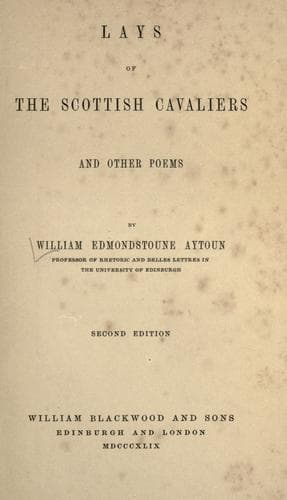
Lays of the Scottish Cavaliers and Other PoemsAytoun, William Edmondstoune
History
Lays of the Scottish Cavaliers and Other Poems
Aytoun, William Edmondstoune
Scotland -- History -- Poetry
Three years after the accession of James VII. Claverhouse was raised to
the peerage, by the title of Lord Viscount Dundee. He was major-general,
and second in command of the royal forces, when the Prince of Orange
landed, and earnestly entreated King James to be allowed to march
against him, offering to stake his head on the successful result of the
enterprize. There is little doubt, from the great popularity of Lord
Dundee with the army, that, had such consent been given, William would
have found more than a match in his old officer; but the King seemed
absolutely infatuated, and refused to allow a drop of blood to be shed
in his quarrel, though the great bulk of the population of England were
clearly and enthusiastically in his favour. One of the most gifted of
our modern poets, the Honourable George Sydney Smythe, has beautifully
illustrated this event.
"Then out spake gallant Claverhouse, and his soul thrilled wild and high,
And he showed the King his subjects, and he prayed him not to fly.
O never yet was captain so dauntless as Dundee!
He has sworn to chase the Hollander back to his Zuyder-Zee."
But though James quitted his kingdom, the stern loyalty of Dundee was
nothing moved. Alone, and without escort, he traversed England, and
presented himself at the Convention of Estates, then assembled at
Edinburgh for the purpose of receiving the message from the Prince of
Orange. The meeting was a very strange one. Many of the nobility and
former members of the Scottish Parliament absolutely declined attending
it, some on the ground that it was not a legal assembly, having been
summoned by the Prince of Orange, and others because, in such a total
disruption of order, they judged it safest to abstain from taking any
prominent part. This gave an immense ascendency to the Revolution party,
who further proceeded to strengthen their position by inviting to
Edinburgh large bodies of the armed population of the west. After
defending for several days the cause of his master with as much
eloquence as vigour, Dundee, finding that the majority of the Convention
were resolved to offer the crown of Scotland to the Prince, and having
moreover received sure information that some of the wild fanatic Whigs,
with Daniel Ker of Kersland at their head, had formed a plot for his
assassination, quitted Edinburgh with about fifty horsemen, and, after a
short interview--celebrated by Sir Walter Scott in one of his grandest
ballads--with the Duke of Gordon at the Castle Rock, directed his steps
towards the north. After a short stay at his house of Duddope, during
which he received, by order of the Council, who were thoroughly alarmed
at his absence, a summons through a Lyon herald to return to Edinburgh
under pain of high treason, he passed into the Gordon country, where he
was joined by the Earl of Dunfermline with a small party of about sixty
horse. His retreat was timeous, for General Mackay, who commanded for
Public-domain text, read in full here on John Shaqi.
Reviews
Reviews
No reviews yet
Be the first to share your thoughts on this work.
Join the Discussion
Join the discussion
Sign in to leave a comment or review.
Sign InorCreate an account