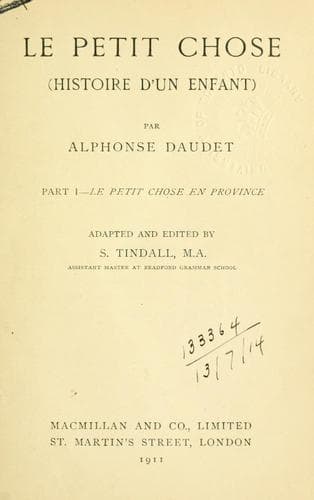
Le Petit Chose (Histoire d'un Enfant)Daudet, Alphonse
General
Le Petit Chose (Histoire d'un Enfant)
Daudet, Alphonse
Autobiographical fiction; Bildungsromans; French fiction -- 19th century; French language -- Readers
The founders and arbiters of the public-school system who ordained that
life in these institutions should be one incessant round of activity from
the beginning of term to its end have perhaps proved to be the children of
wisdom. To a healthy boy who can manage to keep his place in the crowd
without undue straining, there is a tonic effect in the absence of
leisure; and the sense of being a lively part in a great and ever-moving
body is an admirable enemy to stagnation of mind. It is only the special
case, the variant from the type, who suffers when he is included in masses
that move by rule; and if we are inclined to admit the dangerous premise
that any suffering can be good for a young soul, we may cheerfully
conclude that the rough process is justified if it turns the variant
into a solid, ordinary person; or, if he is a hopeless rebel, at least
teaches him that the thorns of life are not tender to him who kicks.
—From _The First Round_, by ST. JOHN LUCAS.
X
Much of the influence he gained over his scholars was attributable to
his knowledge of the individual characteristics of boys. He is said to
have known every boy in the school, his appearance, his habits, and his
companions. It cannot be said that he was always genial in manner;
the youngest boys especially regarded him with awe, and his own sense
of the intense seriousness of life and duty gave a sternness and austerity
to his aspect which made many of his pupils afraid of him. His conception
of a school was that it should be first of all a place for the formation
of character, and next a place for learning and study, as a means for the
attainment of this higher end. Discipline and guidance were in his view
still more prominently the business of a schoolmaster than the impartation
of knowledge. His influence was stimulative rather than formative,
the secret of his power consisting not so much in the novelty of his
ideas or methods as in his commanding and magnetic personality.
—From _Thomas Arnold_, by SIR JOSHUA FITCH.
XI
Public-domain text, read in full here on John Shaqi.
Reviews
Reviews
No reviews yet
Be the first to share your thoughts on this work.
Elsewhere in the archive
Join the Discussion
Join the discussion
Sign in to leave a comment or review.
Sign InorCreate an account