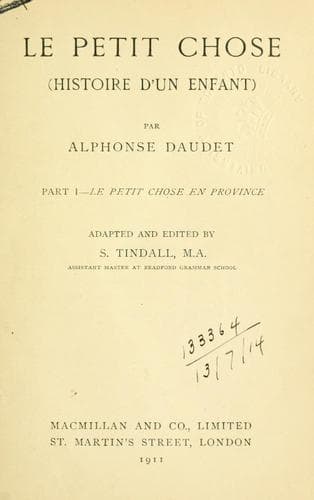
Le Petit Chose (Histoire d'un Enfant)Daudet, Alphonse
General
Le Petit Chose (Histoire d'un Enfant)
Daudet, Alphonse
Autobiographical fiction; Bildungsromans; French fiction -- 19th century; French language -- Readers
He was contented, in a dull kind of way, with the even monotony of
his days. Life at school, he felt, would be always the same; he would
attain no distinctions, but at least he would suffer no violent agonies.
If you could not be brilliant and wonderful it was as well to be
completely insignificant. Defiant eccentricity led to much discomfort,
unless you possessed invincible contempt for ordinary popularity;
and the way of the harmless imbecile was hard at a public school.
When you were at school all the old standards did seem to alter most
strangely. After all, why bother about standards? Why think at all?
School was really pleasanter when you did not think but just drifted.
Yet, could a place where it was better not to think except about everyday
events be really right? All boys were either beasts or worms or geese.
The geese were most numerous, and usually followed and applauded the
beasts. Oh monstrous, stale, unprofitable world!—From _The First Round_,
by ST. JOHN LUCAS.
XII
At present those who pursue philosophy at all are mere striplings just
emerged from boyhood, who take it up in the intervals of business;
and, after just dipping into the most abstruse part of the study,
abandon the pursuit altogether.
And pray what is the right plan?
Just the opposite. In youth and boyhood they ought to be put through a
course of instruction carefully suited to their years; and while their
bodies are growing up to manhood, especial attention should be paid
to them, as a serviceable acquisition in the cause of philosophy.
At the approach of that period during which the mind begins to attain
its maturity, the mental exercises ought to be rendered more severe.
Finally, when their bodily powers begin to fail, and they are released
from public duties and military service, from that time forward they
ought to consecrate themselves altogether to the study of philosophy,
if they are to live happily on earth, and after death to crown the
life they have led with a corresponding destiny in another world.
—From PLATO’S _Republic_, bk. vi.
V. SUJETS DE RÉDACTION
I
_Le soir, après souper, je relisais mon_ Robinson, _je l’apprenais
par cœur; le jour, je le jouais, je le jouais avec rage, et tout
ce qui m’entourait, je l’enrôlais dans ma comédie_ (voir p. 6).
ROBINSON SAUVE VENDREDI
1. Un matin, il aperçoit de loin une trentaine de sauvages,
qui débarquent dans son Île et allument un grand feu. Ils ont avec eux
deux prisonniers, et, pendant qu’ils en tuent un et le découpent pour le
faire rôtir, l’autre s’échappe.
2. Trois des sauvages se mettent à sa poursuite, mais il court plus vite
qu’eux et gagne une crique, qu’il traverse à la nage. Un de ses ennemis
s’arrête, ne sachant pas nager, et les deux autres n’atteignent le bord que
longtemps après le fugitif, qui se dirige précisément du côté de Robinson.
Public-domain text, read in full here on John Shaqi.
Reviews
Reviews
No reviews yet
Be the first to share your thoughts on this work.
Elsewhere in the archive
Join the Discussion
Join the discussion
Sign in to leave a comment or review.
Sign InorCreate an account