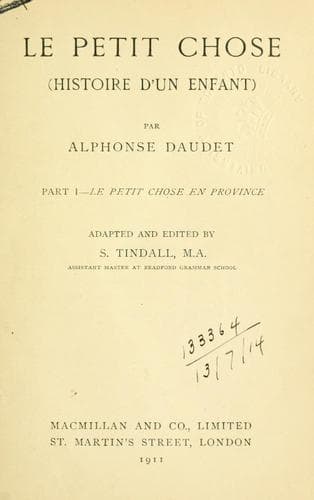
Le Petit Chose (Histoire d'un Enfant)Daudet, Alphonse
General
Le Petit Chose (Histoire d'un Enfant)
Daudet, Alphonse
Autobiographical fiction; Bildungsromans; French fiction -- 19th century; French language -- Readers
For thirty years Daudet, now famous, continued to work, though only
intermittently. He published, with increasing success, _Le Petit Chose_
(1868), _Tartarin de Tarascon_ (1872), _Fromont jeune et Risler aîné_
(1874), _Jack_ (1876), _Le Nabab_ (1877), _Les Rois en exil_ (1879),
_Numa Roumestan_ (1881), _L’Évangéliste_ (1883), _Sapho_ (1884),
_Tartarin sur les Alpes_ (1885), _La Belle Nivernaise_ (1886),
_L’Immortel_ (1888), _Port-Tarascon_ (1890), _Rose et Ninette_ (1892),
_La Petite Paroisse (1895)_, and _Le Trésor d’Arlatan_ (1897).
His last novel, _Soutien de famille_, appeared after his death.
The best known works of his earlier years, besides _Les Amoureuses_,
are his _Lettres de mon moulin_ (1869) and _Les Contes du lundi_ (1873).
Daudet remained all his life the delicate, fragile Petit Chose.
Ten years before his death—which was tragic in its suddenness when it
did come—a severe illness overtook him, and slowly but surely his iron
will broke down under the physical and mental strain which its ravages
had brought on him. One evening, sitting at supper with his family,
he had scarcely begun to eat when he fell from his chair. His wife
and son ran to his assistance, but saw at once that the end had come.
He died in Paris on December 18, 1897.
Daudet was a thorough _Méridional_. Born a Provençal, he never
lost his early affection for the South. Impulsive, fiery in temper,
and rather given to exaggeration, he possessed beneath a cheerful and
handsome exterior a kind, sympathetic heart, and was generous to a fault.
Having known what it was to suffer extreme poverty and feel the pangs
of hunger, he was full of pity for those who had to face the stern
realities of life. He was a close and accurate observer of humanity.
He describes not only what he _felt_ but what he _saw_. When a youth
he always carried a notebook in which he would write down any little
object of interest that came across his path. His characters, however,
are not mere photographs, but pictures of real men and women painted
with the infinite care of a skilled artist. His personality permeates
all he wrote, and in this lies his charm.
In presenting this delightful story of a writer who is probably the
most widely read in France to-day, the Editor has felt reluctantly
compelled to abridge the original text by about fifty pages, so as
to bring it within easy scope of the class-room; but in spite of
these omissions he confidently hopes that the book will not fail
to charm all the students who read it.
S. T.
[1]
LE PETIT CHOSE
I
LA FABRIQUE
Je suis né le 13 mai 18.., dans une ville du Languedoc, où l’on trouve,
comme dans toutes les villes du Midi, beaucoup de soleil, pas mal de
poussière, un couvent de Carmélites et deux ou trois monuments romains.
Public-domain text, read in full here on John Shaqi.
Reviews
Reviews
No reviews yet
Be the first to share your thoughts on this work.
Join the Discussion
Join the discussion
Sign in to leave a comment or review.
Sign InorCreate an account