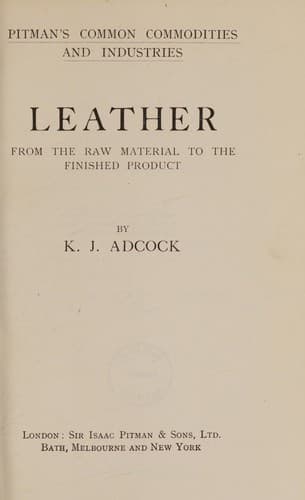
Leather: From the Raw Material to the Finished ProductAdcock, K. J.
History
Leather: From the Raw Material to the Finished Product
Adcock, K. J.
Leather
it has the right consistency and the colour has changed. The reaction
generates great heat, and the "paint" should, therefore, not be used
at once. The flesh side is mopped with the paint and the skins are
folded flesh to flesh. After a few hours, or as soon as the hair
or wool is loosened, the skins are dehaired or dewoolled. The hair
or wool is not allowed to come into contact with the depilitant,
otherwise it would be damaged. In large yards, the white hair is
separated from the coloured, as it is worth nearly twice as much.
Wool is sorted into different qualities, of which the number may vary
from four to eight, or even nine, according to the class of skins
treated. The pelts are then thoroughly washed and placed in lime
liquors, where they remain for one or two weeks, being hauled and set
in the usual manner. Fleshing and piecing or trimming are the next
operations, and then follows the very important process of puering,
which, in the case of glove leather, must be thoroughly done so as to
reduce the pelts to a very soft and flaccid condition. Success in the
making of glove leather depends largely on the "puering" process.
In most of the English tanneries a decoction of dog manure is used,
at a temperature not exceeding 90° F., but on the Continent the
artificial puer, oropon, is preferred. It is much safer to use and
more uniform in its action than excrement, which develops bacteria
rapidly in contact with gelatinous pelts, and could ultimately
destroy them entirely. After puering them, the pelts are well washed
and submitted to the process of drenching, which consists in putting
the skins into a warm infusion of bran or pea-flour and leaving them
covered until the following morning. The slightly acid fermentation
causes the pelts to rise to the top of the vat. They are pushed into
the liquor again with a pole and stirred round. This is repeated
three or four times to prevent damage to the grain. The process is
often done in the paddle-vat (Fig. 25), in which the bran liquor is
circulated for several hours before the pelts are allowed to remain
quiescent. Drenching thoroughly purges the pelts of the last traces
of lime, and puts them in suitable condition for being made into
leather. The pelts are then rinsed in tepid water and "scudded" on
the grain with a slate or vulcanite tool, shaped somewhat like a
dehairing knife. The scud removed consists of dirt, dissolved lime
salts, short hairs, and pigment. Machines are rapidly replacing
manual labour for this operation.
Public-domain text, read in full here on John Shaqi.
Reviews
Reviews
No reviews yet
Be the first to share your thoughts on this work.
Elsewhere in the archive
Join the Discussion
Join the discussion
Sign in to leave a comment or review.
Sign InorCreate an account