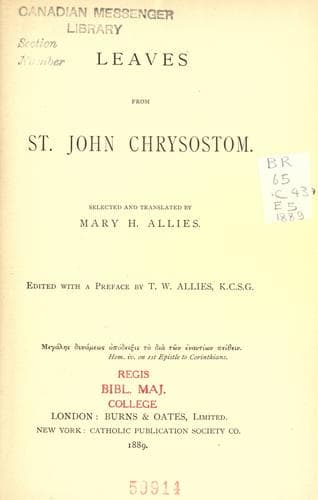
Leaves from St. John ChrysostomJohn Chrysostom, Saint
Religion
Leaves from St. John Chrysostom
John Chrysostom, Saint
Christian literature, Early; John Chrysostom, Saint, -407
palaces are to kings, this kings are at the tombs of fishermen. The
fishermen, like lords of the spot, have taken possession of what is
within; the kings, like sojourners and neighbours, have been contented
to have a separate place in the doorway, thus proving to unbelievers
that pre-eminence in the resurrection will belong to fishermen. For if
it be so here in the matter of tombs, how much more in the resurrection.
And the order is reversed: kings become servants and subjects, whilst
subjects are invested with regal dignity, or rather with something even
greater. The truth itself shows that there is no flattery in the matter,
for kings have become famous through these subjects of theirs. Their
tombs are far more awe-inspiring than those of all kings put together;
there is great solitude in the one and a great crowd at the other. If
you wish to compare these tombs with royal courts, here again they carry
off the palm. Many are the bustling people at the court, but at the tomb
many are they who call and attract rich and poor, men and women, slaves
and freemen. There is great fear at the one, and an unspeakable delight
at the other. But it is a pleasant sight to look upon the king with his
golden sceptre and his crown on his head, his guards standing near, and
princes, and generals, and commanders, and officers high and low. Yet
the spectacle presented by the other is so much more magnificent and
ineffable, that, compared to it, the court would seem to be a puppet
show and child’s play. You have hardly crossed the threshold when the
place carries your mind up to heaven, to the King above, to the army of
the angels, to the throne of the Most High, to glory unspeakable. At
court it falls to the ruler’s part to release one man and to put another
in chains; now, the bones of the saints have not this poor and miserable
authority, but a power far greater. For they call forth demons and
torture them, and release from their sharpest chains those who are
bound. What is more awful than this tribunal? Whilst no one is seen and
no one appears by the devil’s side, there are voices and convulsions,
and blows and torments, and angry tongues, the devil not bearing that
wonderful power. And they who carry those bodies have dominion over
bodiless spirits: dust, and bones, and ashes, tear those invisible
beings into pieces. So it is that no man would ever go a long journey to
see royal palaces, whilst many kings have often travelled far for this
spectacle. For the testimony of the saints furnishes a likeness and a
symbol of the judgment to come, devils are punished, men are chastised
and set free. See you the power of the saints even when they are dead,
and the weakness of sinners even whilst living? Fly therefore from evil,
that you may have dominion over these, and pursue goodness with all
zeal. For, if things so wonderful take place here, judge what it will be
like hereafter.
· · · · · · ·
Public-domain text, read in full here on John Shaqi.
Reviews
Reviews
No reviews yet
Be the first to share your thoughts on this work.
Elsewhere in the archive
Join the Discussion
Join the discussion
Sign in to leave a comment or review.
Sign InorCreate an account