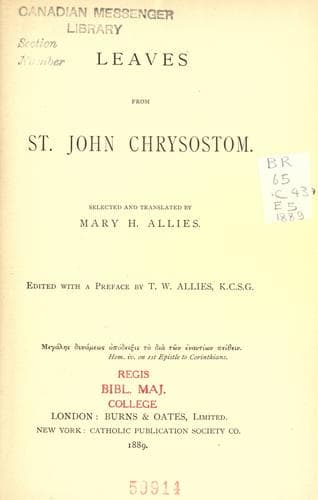
Leaves from St. John ChrysostomJohn Chrysostom, Saint
Religion
Leaves from St. John Chrysostom
John Chrysostom, Saint
Christian literature, Early; John Chrysostom, Saint, -407
Now, what does Christ say? He reveals their conscience to them, and
answers this feeling rather than their mere words. _Calling unto Him a
little child, He said: Unless you be converted and become as little
children, you shall not enter into the kingdom of heaven._ ‘You, indeed,
enquire who is the greater, and dispute about the first places; _I_ tell
you that he who has not become meeker than all the rest is not worthy
even to enter into that kingdom.’ And He brings the example before them
in a beautiful way; and not only does He bring it before them, but He
sets the child in the midst of them, admonishing them by the sight, and
urging them to be both humble and unaffected. For a child is free from
envy and from vainglory, and from the love of the first places, and he
possesses the greatest virtue—simplicity, and unaffectedness and
humility. It is not sufficient to have courage and prudence, but this
virtue also: I mean humility and simplicity. For with the greatest, our
salvation will be at fault, if we have not these. Contempt, blows,
honour, or praise cause a child neither annoyance nor envy, nor is he
thereby inflated. Do you see again how He excites us to natural
qualities, showing us that these may be rightly directed by a free
choice, and how He thus condemns the wretched fury of the Manicheans?
For if nature be bad, why does He take from nature illustrations in
favour of asceticism? The child seems to me most truly a child standing
in the midst of them, free from all these passions. Such a child,
indeed, is without folly, and the love of reputation, without jealousy
and envy, and every affection of the kind; and having many
virtues—simplicity, humility, unmeddlesomeness—he is not puffed up by
any one of them; it is doubly wise to possess these things and not to be
vain of them. This is why Our Lord called the child and set him in the
midst of them; nor did He close His argument here, but He adds this
further exhortation, saying: _He who shall receive one of these children
in My name receives Me_. ‘Not only if you have become like to them shall
you have a great reward, but also if you honour those like them for My
sake, I will give you a kingdom as a reward for your honour of them.’ He
says, indeed, more than this in the words _receives Me_. Thus, ardently
am I to desire meekness and unaffectedness. Hence He calls men who ate
thus simple and humble, and cast off by the multitude, and despised,
children.
· · · · · · ·
The First are Last and the Last First.
(_Homilies on St. Matthew_, lxvii., vol. ii., p. 285.)
· · · · · · ·
Let no sinner despair: let no just man give way to sloth. Neither let
the just be presumptuous, for it often happens that the harlot outstrips
him; nor let the sinner be downcast, for he may overtake those who are
first.
Public-domain text, read in full here on John Shaqi.
Reviews
Reviews
No reviews yet
Be the first to share your thoughts on this work.
Join the Discussion
Join the discussion
Sign in to leave a comment or review.
Sign InorCreate an account