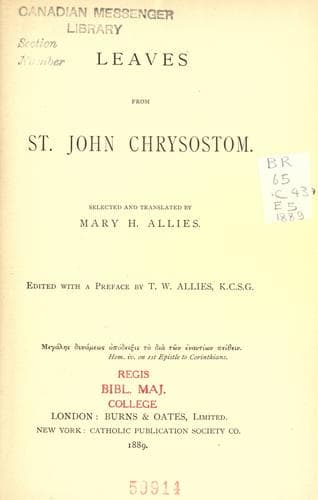
Leaves from St. John ChrysostomJohn Chrysostom, Saint
Religion
Leaves from St. John Chrysostom
John Chrysostom, Saint
Christian literature, Early; John Chrysostom, Saint, -407
Listen to what God says to Jerusalem: _I said all these things after her
adultery, Turn to Me, and she did not turn_. As often as we return to
the burning charity of God, He no longer remembers our former sins. God
is not as man: He does not reproach those who come to Him, or say, if we
be really changed, ‘Why hast thou wasted so much time?’ but He loves us
whenever we go to Him. Let us only go to Him in the right way. Let us
cling fast to Him, and nail our hearts to His fear. These things have
taken place not only recently, but they happened also of old. What was
worse than Manasses? Yet he was able to appease God. Who was more
blessed than Solomon? But torpor made him fall. Indeed, I can show the
two things happening in one man; in Solomon’s father, for he himself was
just and became wicked. Who was more blessed than Judas? Yet Judas
became a traitor. What could be more miserable than Matthew? But he
became an evangelist. What was worse than Paul? Still, Paul became an
apostle. Who was more zealous than Simon? And yet Simon himself became
the most wretched of all. How many more of the same vicissitudes would
you contemplate—those both of the past and those which are taking place
every day? So I say, neither let the man who is on the stage despair,
nor let the man who is in the Church make too bold. To the latter it was
said: _He who seems to stand, let him be careful lest he fall_, and to
the former: _Does the fallen man not rise up again?_ and, _Restore
languid hands and disabled knees_. Again, to the just it was said:
_Watch_, but to sinners: _Arise, thou who sleepest, and rise from the
dead_. The former have need to watch over what they possess, and the
latter to become that which they are not as yet: the just to preserve
their health, sinners to put off their sickness. For they _are_ sick,
but many of the sick are sound, and some of the sound, by their
carelessness, become sick. For it was to these that Our Lord said, _Go,
thou art sound: sin no more, lest something worse should befal thee_;
but to sinners, _Wilt thou be made sound? Take up thy bed and walk, and
go into thy house._ Sin is indeed a dire paralysis, or, rather, it is
not only a paralysis, but something more fearful. For a paralysed man is
not only lacking good things, but is also a prey to bad ones. Still, if
you are even in this state, and are willing to make a small effort to
rise, all sins are remitted. Even if your sickness has lasted
thirty-eight years, yet you strive to become sound: there is no one to
prevent you. Christ is at hand now as then, and He says, _Take up thy
bed_. Only be willing to rise; do not lose heart. Have you no man? You
have God. Have you no one to put you into the pool? But you have One Who
will not allow you to require the pool in vain. Have you no one to hold
you in it? You have One Who commands you to take up your bed. You have
not to say, _When I come, another gets down before me_. For if you wish
Public-domain text, read in full here on John Shaqi.
Reviews
Reviews
No reviews yet
Be the first to share your thoughts on this work.
Join the Discussion
Join the discussion
Sign in to leave a comment or review.
Sign InorCreate an account