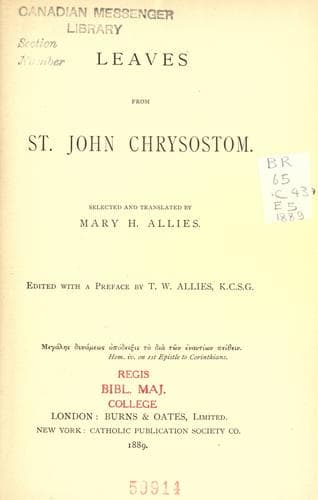
Leaves from St. John ChrysostomJohn Chrysostom, Saint
Religion
Leaves from St. John Chrysostom
John Chrysostom, Saint
Christian literature, Early; John Chrysostom, Saint, -407
to go down to the fountain no man hinders you. Charity is not spent nor
consumed: it is a source which is always flowing upwards: out of His
fulness we are all cured as to our soul and as to our body. Now,
therefore, also, let us approach Him. Rahab was a harlot, yet she was
saved; and the thief was a murderer, but he became a citizen of
paradise; and Judas, being in the society of the Master, was lost,
whilst the thief on the cross became a disciple. These are God’s
paradoxes. Thus it was that the Magi found favour, that a publican
became an evangelist, and a blasphemer an apostle.
Consider these things, and never despair, but be of good heart always,
and raise yourself up. Keep to that path alone which leads above, and
you will make rapid progress. Close not the doors nor block up the
entrance. This time is short and the labour small. And if it were heavy,
even then we should not refuse it. For if you are not weary with this
most delicious weariness of wisdom and virtue, you will be weary with
the weariness of the world, and will be worn out in another way. But if
there be weariness here too, why do we not choose for ourselves that
other which is so productive of fruit and has so great a reward? And yet
this last weariness is not as the former. For in worldly things there
are always risks and continuous penalties: hope is uncertain, much
slavery of spirit is required, and there is expenditure of money, and of
strength of body and of mind, and even then the compensation of results
is far below the expectation, if there be any results at all. The sweat
and toil of worldly business do not, indeed, in all cases produce fruit.
Even in those instances in which they are not fruitless, but rich in
results, these are short-lived. For it is when you grow old, and have no
longer an acute sense of enjoyment that your labour yields its fruit.
The hard work falls to the lot of the body at its prime, whereas the
fruit and its enjoyment come when it is worn and aged, and time has
dulled its perceptions, or, if it has not dulled them, the prospect of
an approaching end forbids enjoyment. It is not so in the other case,
but labour is the part of a mortal and corruptible body, and the crown
belongs to a glorified and immortal one which is eternal. The labour
comes first and is slight, but the reward comes last and is infinite, so
that you may rest with security and be untroubled as to the future.
There is no fear of change or of misfortune as there is here on earth.
What goods, then, are these—insecure, slight, and earthly, which
disappear before they appear, and are possessed with so much toil? How
are they equal to those immutable, undecaying good things which are free
from all hardships, and crown you in the time of warfare? The man who
despises money receives his reward even on earth: he is free from care
and envy, slander, treachery, and heart-burnings. The wise man, he who
lives decorously, is crowned and in luxury before his flight hence, in
Public-domain text, read in full here on John Shaqi.
Reviews
Reviews
No reviews yet
Be the first to share your thoughts on this work.
Join the Discussion
Join the discussion
Sign in to leave a comment or review.
Sign InorCreate an account