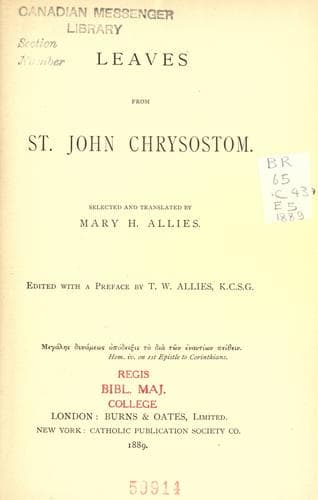
Leaves from St. John ChrysostomJohn Chrysostom, Saint
Religion
Leaves from St. John Chrysostom
John Chrysostom, Saint
Christian literature, Early; John Chrysostom, Saint, -407
_And behold one came and said to Him: Good Master, what shall I do that
I may inherit eternal life?_ Some reject this young man as insidious and
bad. I, however, would not deny that he was a lover of money, and unable
to resist it, since Christ convicted him of this; but I should not admit
that he was insidious, because it is not safe to make a venture upon
what is unknown, especially in accusations, and because St. Mark has
removed this doubt. For he says _that running up and kneeling before_
Him, he asked Him a question, and again, that _Jesus, looking upon him,
loved him_. But great is the tyranny of money as we gather from this;
for even if we be quite faultless as to other things, it alone spoils
everything else. St. Paul too justly called it the root of all evils.
_The love of money_, he says, _is the root of all evils_. Now, why did
Our Lord answer him by saying, _No man is good_. Because the youth
approached Him as a mere man, as one of many, and a Jewish teacher: on
this account Our Lord spoke as man to man with him. For He frequently
answers according to the secret mind of those who come to Him, as, for
instance, when He says, _We adore what we know_, and, _If I bear witness
to Myself, My witness is not true_. When, then, He says, _No man is
good_, He does not say it to repudiate His own goodness—far from it; for
He does not say, ‘Why do you call _Me_ good? I am not good,’ but, _No
man is good_, that is, no man at all.
When He speaks in this way, He is not defrauding men of all goodness,
but making a distinction as to God’s goodness. So He added: _Only God is
good_. And He did not say, ‘Only my Father,’ that you may know that He
did not disclose Himself to the youth. Thus, higher up, He called all
men bad, saying, _But if you who are bad know how to give good gifts to
your children_. And if He called them wicked in this place, He did not
condemn human nature as altogether bad (for He says _you_, not ‘you, the
human race’). He so called them, because He was putting the goodness of
man by the side of the goodness of God, and therefore He added, _How
much more will your Father give good gifts to those who ask Him_. And,
you may say, what necessity or advantage was there that He should answer
the young man in this way? He leads him up by degrees, teaches him to
put off all deception, withdraws him from the things of earth, nailing
him to God, inducing him to seek the things to come, to know the good,
the root and foundation of all things, and to refer honour back to Him.
And thus when He says, _You shall call no man master upon earth_, He
said it to make a distinction as to Himself, that they might learn Who
was the first Beginning of all things. For, so far, the young man had
shown no slight willingness by rushing eagerly to embrace this love; and
whilst others had come, some to tempt, others for the curing of disease,
whether it was their own or their neighbours’, he had come and had
spoken for the sake of eternal life.
Public-domain text, read in full here on John Shaqi.
Reviews
Reviews
No reviews yet
Be the first to share your thoughts on this work.
Join the Discussion
Join the discussion
Sign in to leave a comment or review.
Sign InorCreate an account