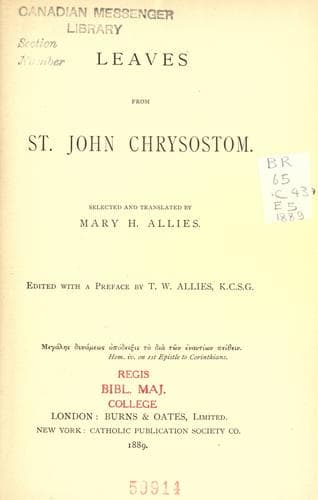
Leaves from St. John ChrysostomJohn Chrysostom, Saint
Religion
Leaves from St. John Chrysostom
John Chrysostom, Saint
Christian literature, Early; John Chrysostom, Saint, -407
The soil indeed was rich and moist,
but the brambles overpowered and stifled the seed. For consider how far
up to this point he is disposed to obey commands. _What shall I do_, he
says, _that I may inherit eternal life?_ Thus ready was he to accomplish
what he should be told. But if he had come to Our Lord to tempt Him, the
Evangelist would have told us so, as he does in other instances, and in
that of the advocate. But if the young man was silent, Christ would not
have allowed him to escape unknown, but would have convicted him wisely,
or have hinted at his meaning, so that the youth should not think he had
deceived and escaped without recognition, and so have been misled. If he
had come to tempt, he would not have gone away sad, because of what he
heard. This, at least, was not what any one of the Pharisees of the day
did; but when they were silenced, they were angry. It was not so with
the young man: _he_ went away cast-down, which was no small proof that
he had come with a weak rather than a bad intention, with the desire of
life, but weighed down by another and a stronger passion.
Therefore, when Our Lord said, _If thou wilt enter into life, keep the
commandments_, he asks, _Which commandments?_ This was not said
tempting—far from it—but thinking that he was to know of other
commandments besides those of the Law, which would help him to life.
This showed a great desire on his part. Then, when Jesus enumerated
those of the Law, he said, _All these have I kept from my youth_. And he
did not stop his enquiry here, but asked further, _What is yet wanting
to me?_ which in itself was a proof of his eagerness. His thinking
himself to be still wanting in something, and his deeming that the
things already specified were not sufficient, was no small step towards
gaining what he desired. What does Christ say? As He was about to
accomplish a great work, He put the prize before the youth and said, _If
thou wouldst be perfect, go, sell what thou hast and give to the poor,
and thou shalt have a treasure in heaven, and come and follow Me_. Do
you see what rewards and crowns He sets for this career? If the young
man had been tempting, he would not have spoken these things to Him. But
now He does speak, and, as it were, draws him to Himself, shows him the
reward to be exceedingly great, and unfolds the whole before his mind,
hiding throughout the semblance of irksomeness in the advice. Therefore,
before speaking of the combat and the labour, He shows him the reward,
saying, _If thou wilt be perfect_; then He adds, _Go, sell what thou
hast and give to the poor, and_, again returning to the rewards, _thou
shalt have a treasure in heaven, and come and follow Me_. For the
following Him is a great compensation. _And thou shalt have a treasure
in heaven._ Hence, as the matter turned on money, and He was exhorting
the young man to strip himself of everything, He points out that He does
not take away possessions, but adds to them, and that He gives more
Public-domain text, read in full here on John Shaqi.
Reviews
Reviews
No reviews yet
Be the first to share your thoughts on this work.
Join the Discussion
Join the discussion
Sign in to leave a comment or review.
Sign InorCreate an account