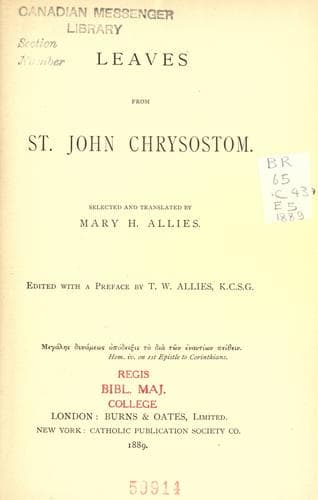
Leaves from St. John ChrysostomJohn Chrysostom, Saint
Religion
Leaves from St. John Chrysostom
John Chrysostom, Saint
Christian literature, Early; John Chrysostom, Saint, -407
Let us now consider the various forms which friendship takes with the
majority of men. One man loves because he is loved; another because he
has been honoured; another shows a liking for a man who has been of use
to him in some practical matter or other; another, again, for some such
similar reason; but it is difficult, indeed, to find a man who loves his
neighbour thoroughly and as he ought for Christ’s sake. For in most
cases it is temporal business which brings men together. St. Paul did
not love in this way: he loved for Christ’s sake, so that he loved
others whether he was loved by them or not, and did not break charity,
since he had laid a strong foundation for his love-charm. It is not so
now; indeed, if we search diligently, we shall find in most men a
fictitious friendship rather than this. And if anyone gave me power to
enquire into the matter in so great a multitude, I could show that the
majority are bound to each other for worldly reasons. This is apparent
from the causes which produce enmity. Since, then, men are bound to each
other for motives so paltry, there is neither warmth nor fidelity in
their mutual dealings; but contempt, and money losses, and jealousy, the
love of honour, or any similar thing showing itself, destroys the
love-charm. It rests not upon a spiritual foundation. If it were so,
worldly things would never break up spiritual things. The love, indeed,
which is born of Christ is strong and enduring and invincible, and
nothing has power to dissolve it—neither calumnies, nor dangers, nor
death, nor any other of these things whatsoever. If a man who thus loves
should suffer in a thousand ways, contemplating that on which love
rests, he stands unmoved. But the man who loves because he is loved, if
he should suffer some foolish thing or other, breaks up his friendship,
whilst the former is firm to the end. This is why St. Paul said,
_Charity never falleth away_. What answer would you make? That the man
whom you have honoured is a reviler? or that the one whom you have
benefited would wish to put you to death? But if you love for Our Lord’s
sake, this encourages you to love all the more. For those things which
are destructive to love in other cases become productive of it in this
particular one. How so? In the first place, because the man so loved is
the cause of your reward; secondly, because one thus situated requires
special help and much care. On this account a man who loves for Our
Lord’s sake does not enquire about family, or country, or riches, or
demand love in return: he concerns himself about none of these things,
but even if he be hated, or despised, or destroyed, he still loves,
because his affection is built on a strong foundation—Christ. Hence he
stands firm, steadfast, immutable, with his eyes on Our Lord. So it was
that Christ loved His enemies—harsh men, scoffers, blasphemers, haters,
those who wished not even to see Him, those who preferred stones and
Public-domain text, read in full here on John Shaqi.
Reviews
Reviews
No reviews yet
Be the first to share your thoughts on this work.
Join the Discussion
Join the discussion
Sign in to leave a comment or review.
Sign InorCreate an account