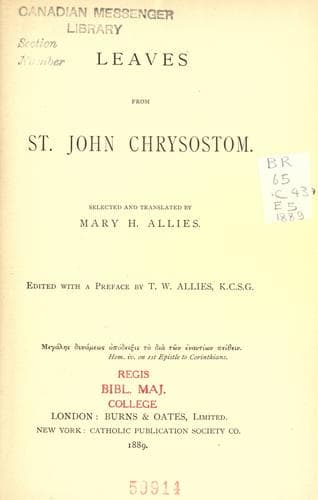
Leaves from St. John ChrysostomJohn Chrysostom, Saint
Religion
Leaves from St. John Chrysostom
John Chrysostom, Saint
Christian literature, Early; John Chrysostom, Saint, -407
wood to His love, and He loved them with the charity from above, in
comparison with which there is no other charity to be found. _For_, He
says, _no man hath greater charity than this, that he giveth his life
for his friends_. See how loving He ceases not to be towards the very
men who crucified Him and reviled Him. He even spoke for them to His
Father, saying, _Forgive them, for they know not what they do_. And,
later on, He charged His disciples with those same men. Let us, then, be
zealous for this same charity, and strive to possess it, that, being
made the imitators of Christ, we may enjoy both present and future good
things by the grace and tenderness of Our Lord Jesus Christ, to Whom be
honour and glory for ever and ever. Amen.
The Buyers and Sellers in the Temple.
(_Homilies on St. Matthew_, lxvii., vol. ii., p. 277.)
_And Jesus went into the temple of God, and cast out all them that sold
and bought in the temple, and overthrew the tables of the
money-changers, and the chairs of them that sold doves. And He saith to
them: It is written, My house shall be called the house of prayer; but
you have made it a den of thieves._ John says the same thing, but he
says it in the beginning of his gospel, whereas Matthew says it towards
the end. Hence it is evident that the thing recounted took place twice
and at different times. This is clear from the time and from the answer.
In St. Matthew it happened at the very time of the Pasch; in St. John a
good deal before it. In the latter the Jews say, _What sign dost Thou
show us?_ but in the former they are silent as if rebuked, because He
was an object of wonder to all men. His doing the same action twice, and
this in an authoritative way, strengthens the charge against the Jews,
for they remained at their traffic, and called Him God’s enemy, when
they should have learnt from this His action how much He honoured His
Father and what His own power was. For He was working wonders, and they
saw a correspondence between His words and His deeds. Still they were
unmoved and discontented, and this in the face of the loud testimony of
the Prophet and of children witnessing to Him, with a wisdom beyond
their years. This is why He Himself uses as an arm against them the
accusing words of Isaias: _My house shall be called the house of
prayer_. He shows His power not only in this way, but in the curing of
many kinds of diseases; for the lame and the blind came to Him and He
cured them, and He shows forth His power and His authority. They,
however, were not persuaded in this way; but after seeing these wonders,
and listening to children bearing witness to Him, they say, _Dost Thou
not hear what these say?_ This was what Christ might have said to
_them_: ‘Do you not hear what these say?’ for they sang to Him as to
God. What does He do? Since they spoke against visible signs, He makes
use of a stronger correction, saying, _Have you never read, Out of the
Public-domain text, read in full here on John Shaqi.
Reviews
Reviews
No reviews yet
Be the first to share your thoughts on this work.
Join the Discussion
Join the discussion
Sign in to leave a comment or review.
Sign InorCreate an account