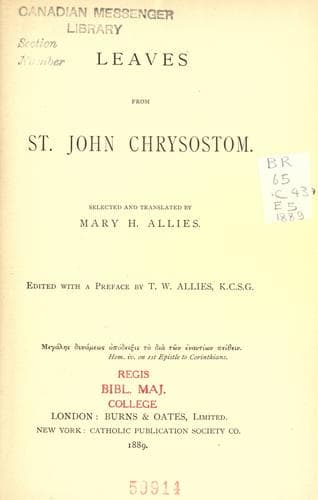
Leaves from St. John ChrysostomJohn Chrysostom, Saint
Religion
Leaves from St. John Chrysostom
John Chrysostom, Saint
Christian literature, Early; John Chrysostom, Saint, -407
Consequently, there having been no
learning about the preaching of the Gospel is no lessening of its value,
but its greatest glory. This, at least, shows it to be divine, and to
have had its root above, in heaven. On this account he continued: _That
your faith may not be in the wisdom of man, but in the power of God_. Do
you see how clearly in everything he pointed out the gain of
illiterateness and the harm of culture? While human wisdom made the
Cross vain, ignorance proclaimed the power of God: the one disposed men
not to find the necessaries of life, and so to glory in themselves; the
other, to receive the truth and to glory in God. Again, wisdom persuaded
many men to regard dogma suspiciously as human; ignorance pointed it out
clearly as divine, and coming down from heaven. Now, whenever a proof is
arrived at by word-wisdom, it is very often the bad men who get the
better of the more moderate, being the more skilful in their arguments,
and falsehood outwits the truth. It is not so here: for neither does the
Holy Spirit take possession of an unclean soul, nor when He has taken
possession can He be ever lessened, even if all the clever words in the
world be used. A manifestation through works and signs is much clearer
than that of words.
But some one might reasonably say that, if the Gospel is bound to
conquer, and the Cross needs no eloquence, that it may not be proved
vain, why is it that miracles have now ceased? Why is it? Do you speak
as an unbeliever, and not receive those which took place in the case of
the Apostles, or do you honestly seek to learn? If as an unbeliever,
then I will first direct myself to this. Now, if miracles did _not_ take
place then, how did they make themselves heard, standing up against
whole peoples and speaking such things, driven about as they were,
pursued, in fear, in chains; one and all an object of hatred to the
world; at the mercy of everyone’s ill-treatment; having nothing
attractive of their own—neither eloquence, nor fame, nor riches, nor
city, nor nationality, nor family, nor career, nor reputation, nor any
one of these things, but just the reverse of them all, an illiterate and
sorry condition, poverty, hatred, and enmity? Their injunctions also
entailed much hardship and their teaching many dangers, and the hearers
too who were to be persuaded were given up to much feasting and
drunkenness and vice. Now, tell me, whence their power of persuasion,
whence their titles of credence? As I was saying, if they _did_ gain men
without miracles, the wonder appears very much greater. Therefore do not
conclude that because there are no miracles now there were none then. It
was to the point, both that they took place then and that they do not
take place now. Persuasion by word alone now is no security that the
Gospel lies in the possession of wisdom. For they who in the beginning
were sowers of the Word were uncultured and ignorant, and they spoke
Public-domain text, read in full here on John Shaqi.
Reviews
Reviews
No reviews yet
Be the first to share your thoughts on this work.
Join the Discussion
Join the discussion
Sign in to leave a comment or review.
Sign InorCreate an account