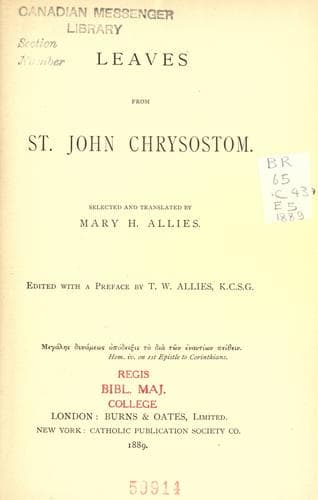
Leaves from St. John ChrysostomJohn Chrysostom, Saint
Religion
Leaves from St. John Chrysostom
John Chrysostom, Saint
Christian literature, Early; John Chrysostom, Saint, -407
This is how the folly of God is wiser than man, and His weakness
stronger. How is it stronger? It is stronger in that it spread over the
whole earth and seized all men by force, and whereas thousands and
thousands did their utmost to stamp out the name of the Crucified One,
just the contrary came to pass. For this name took root and was
propagated all the more, whereas _they_ were destroyed and consumed, and
living men fighting a dead One, gained not a stroke. Consequently when a
heathen tells me that I am a fool, he proves that he himself is doubly
one; inasmuch as considered by him to be a fool, I appear wiser than the
wise; and when he calls me weak, he shows himself to be weaker. For
publicans and fishermen set up those very things by the goodness of God
which philosophers, and orators, and despots, and the whole world vainly
striving with all its might could not even devise.
What, indeed, has the Cross not introduced? The belief concerning the
immortality of the soul, and the resurrection of the body, the despising
of present things, the desire of eternal. And it made angels out of men,
who practise everywhere the philosophy of all endurance. But amongst
heathens, too, you say, ‘There have been many who have despised death’.
Tell me who they are. Do you allude perchance to the drinker of hemlock?
But, if you like, I will show you thousands of such men in the Church.
For if, when a persecution came, all men could get off by taking
hemlock, they would all have been more illustrious than he was. Besides,
he drained the cup, not being free to drink or not to drink: willing or
unwilling, he had to suffer, which was not courage, but necessity.
Thieves and murderers under sentence of their judges have suffered
harder things. It is just the very contrary amongst us; for the martyrs
endured, not in spite of themselves, but willingly, and having it in
their power not to suffer, showed forth a fortitude beyond all proof.
Therefore it is not surprising if Socrates drank hemlock, both because
he could not do otherwise, and because he had reached extreme old age,
for he said that he was seventy years old when he despised life, if this
be indeed despising it; _I_ should not say so, nor would anyone else.
But show me a man rejoicing in torments for his belief, as I can show
_you_ thousands all over the world. Who bore bravely the tearing out of
his nails, the racking of his joints, the hacking asunder of his
members, one after the other, the stretching upon a gridiron, or
plunging into a caldron? Show me this. For death by hemlock is
equivalent to slumbering quietly away, as it is said to be an end which
is sweeter than sleep. And if certain men have even endured torments,
they have forfeited the praise due to them by dying for criminal causes:
some for betraying secret things, others for aiming at domination,
others for being taken in the most shameful deeds; others, again, either
vainly or foolishly, without any cause, have destroyed themselves. But
Public-domain text, read in full here on John Shaqi.
Reviews
Reviews
No reviews yet
Be the first to share your thoughts on this work.
Elsewhere in the archive
Join the Discussion
Join the discussion
Sign in to leave a comment or review.
Sign InorCreate an account