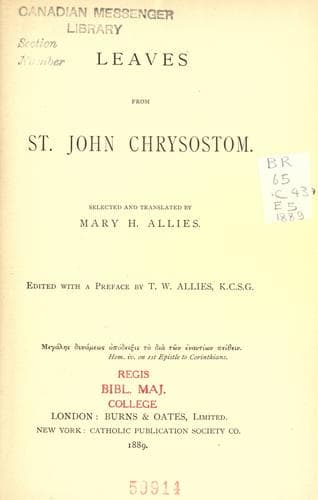
Leaves from St. John ChrysostomJohn Chrysostom, Saint
Religion
Leaves from St. John Chrysostom
John Chrysostom, Saint
Christian literature, Early; John Chrysostom, Saint, -407
it is not so with us. And this is why their deeds have been hushed in
silence, whilst ours are flowering and increasing day by day. This was
in Paul’s mind when he said: ‘The weakness of God is stronger than all
men put together’. For the divinity that was in the tidings is clear
from this. How, indeed, was it that twelve unlettered men attempted
things of this importance, twelve men, whose life was spent on seas and
rivers and in deserts, who scarcely entered city or marketplace? How did
they manage to set themselves in battle array over the whole world? The
recorder of their deeds shows them to have been faint-hearted and
unmanly, and himself to have no desire to conceal their shortcomings,
which were themselves the greatest proof of the truth. Now, what does he
say about them? That when Christ was taken, after seeing Him work
countless wonders, some fled, and the one who remained, the chief of
all, denied Him. How was it, then, that those who, whilst Christ lived,
could not endure Jewish anger, should have been able to range themselves
against the whole earth after He was dead and buried, if, as heathens
say, He did not rise from the dead, nor have any communication with
them, nor infuse courage into them? Would they not have said to
themselves, ‘How is this? He was not powerful enough to save Himself,
and will He help us? He did not help Himself whilst alive, and will He,
now that He is dead, put out His hand to us? In life He did not gain
over even one people, and shall we persuade the whole world by speaking
His name?’ And, indeed, how would it be reasonable not only to do these
things, but even to conceive the doing? Whence it is evident that if
they had not seen His resurrection, and had not witnessed a very great
proof of His power, they would not have made such a venture. For if they
had, indeed, numberless friends, would they not have made enemies of
them all by disturbing ancient customs and removing ancestral landmarks?
Now, they had all for enemies both at home and abroad. But if they had
been in universal veneration on account of outward gifts, would not all
men have detested them for introducing a new manner of life? Seeing,
however, that they were without all these things, this in itself would
have been enough to make them hated and despised by all.
· · · · · · ·
The Abode of the Humble.
(_Homilies on St. Matthew_, lxxii., vol. ii., p. 344.)
· · · · · · ·
Public-domain text, read in full here on John Shaqi.
Reviews
Reviews
No reviews yet
Be the first to share your thoughts on this work.
Elsewhere in the archive
Join the Discussion
Join the discussion
Sign in to leave a comment or review.
Sign InorCreate an account