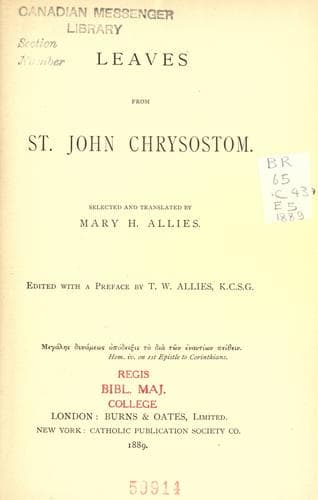
Leaves from St. John ChrysostomJohn Chrysostom, Saint
Religion
Leaves from St. John Chrysostom
John Chrysostom, Saint
Christian literature, Early; John Chrysostom, Saint, -407
_He who humbleth himself shall be exalted._ Where shall we find this
humility? Would you like to go once more to the abode of goodness, to
the tents of the blessed, I mean, to the mountains and forests? For it
is there that we shall see this perfection of humility. They are men,
some famous for outward position, some for wealth, who humble themselves
in every particular, in their food, in their dwelling, in their
servants, and so in all their life they are writing the word _humility_
as if with pen and ink. Just as smart dressing and a fine house and a
large establishment are incentives to vainglory, which thrust men into
it, often in spite of themselves, all these things are cut off in the
desert. Those men light their own fire, hew their wood, do their own
cooking, and themselves wait upon guests. Insult is neither given nor
taken, no man is ruled, no man rules, but all are ministering. Each man
washes the stranger’s feet, and there is much contention as to who shall
do it. This he does, not seeking to find out who the stranger is,
whether a slave or a free man; in each case he carries out this service.
No man is either great or small. Is there confusion then? God forbid, it
is rather the perfection of harmony. If, indeed, a man there be of small
account, he who is great does not regard it, but deems himself inferior,
and so becomes greater.
Both servers and served eat at one and the same table, have the same
food, the same clothes, the same lodging, the same rule of life. He is
great there who is eager over a lowly task. Mine and thine do not exist,
and the thing itself, the cause of endless strife, has been banished.
And why do you wonder that there is one rule, one table, and one dress
for all, where there is one spirit in all, not according to the body
only (for this is the case with all men), but according to charity? For
how could charity ever be set against itself? Neither poverty nor riches
are to be found there, neither fame nor disgrace. How, then, could folly
or vainglory creep in? Some are great, some are little amongst the
number according to a moral reckoning, but as I was saying, no one takes
note of it. The weak man does not grieve as being despised, for there is
no one to despise him. Even should anyone insult another, this is their
principal training, bearing contempt and contumely and shabby treatment
both in word and act; they live with the lowly and the maimed, for these
are the guests of their repasts, and thus they are worthy of heaven. One
dresses sores, another leads the blind, another supports the lame. There
are neither flatterers nor parasites, or rather they do not even
apprehend what flattery is. How, then, could they ever be puffed up? For
a great equality reigns among them, consequently the contentedness
produced by goodness. In this way the most wretched are better taught
than by being obliged to give them the first places. Just as a meek man
schools an impetuous man to lowliness, so does a man who makes no
Public-domain text, read in full here on John Shaqi.
Reviews
Reviews
No reviews yet
Be the first to share your thoughts on this work.
Elsewhere in the archive
Join the Discussion
Join the discussion
Sign in to leave a comment or review.
Sign InorCreate an account