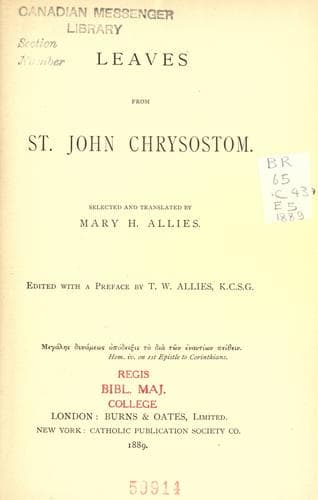
Leaves from St. John ChrysostomJohn Chrysostom, Saint
Religion
Leaves from St. John Chrysostom
John Chrysostom, Saint
Christian literature, Early; John Chrysostom, Saint, -407
But the ‘Court’s stern martyr-guest,’ who was also ‘the glorious
preacher with soul of zeal and lips of flame,’ could not go on long
practising the life of a saint with the power of a patriarch under such
sovereigns as the weak Arcadius and the imperious Eudoxia. His virtues
offended many in a city of intense worldliness. His censures, delivered
with his wonted eloquence from the pulpit of the cathedral, roused great
enmities. In Theophilus, patriarch of Alexandria, he had a watchful
enemy, eager to punish, in the person of Chrysostom, the new rank which
his see arrogated of being the second in the Church, as the see of Nova
Roma. By that arrogation, the see of St. Mark at Alexandria was degraded
from a rank which it had held since the beginning of the Christian
hierarchy. Not only among the magnates of the court, but among his
brother bishops, Chrysostom found much opposition: and at last the
empress set herself at the head of his opponents. While he was absent in
Asia Minor, restoring to order the exarchate of Ephesus, Severian,
bishop of Gabala in Syria, sought, by sermons delivered in the cathedral
itself, to take from him the favour of the people. But it received him
with acclamation on his return, and drove Severian out of the city.
Synod of the Oak
But certain disturbances about the doctrine of Origen which had broken
out among the monks in Egypt involved him in unfortunate difficulties.
Among many monks who fled to Constantinople from the desert of Nitria in
Egypt, under excommunication from Theophilus, were the ‘four tall
brothers’. They came to accuse their patriarch before the emperor and
Chrysostom. He took them up, showing kindness and sympathy, though he
did not admit them to communion. Theophilus was summoned to
Constantinople by the emperor, to answer for his conduct before a synod.
To escape this humiliation he used every effort to ruin Chrysostom, whom
he took to be his own opponent. He accused Chrysostom himself of
Origenism. This scheme of the Egyptian patriarch brought over to his
side all the opponents of Chrysostom at the court. Theophilus even
ventured to appear as the accuser and judge of the patriarch in the
capital itself. He was able to draw together a synod of thirty-six
bishops at the Oak, a country-house near Chalcedon, and to summon the
bishop of Constantinople to appear before it. Chrysostom, on the double
ground of his own rank and his innocence, refused to appear. The
unlawful synod ‘of the Oak’ condemned him, supported by the influence of
the empress. Forty bishops around him in Constantinople attested his
innocence, and objected to a proceeding utterly unlawful and, until
then, unknown. Chrysostom was willing to obey a command of the emperor
that he should cross the Bosphorus and attend; but the people threatened
insurrection if the command were not withdrawn. Chrysostom had to
return, and was reseated in his church with the joyful acclamation of
his people.
Public-domain text, read in full here on John Shaqi.
Reviews
Reviews
No reviews yet
Be the first to share your thoughts on this work.
Join the Discussion
Join the discussion
Sign in to leave a comment or review.
Sign InorCreate an account