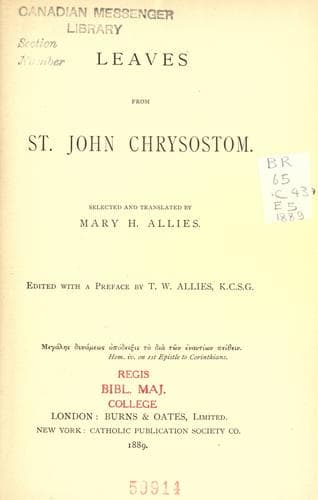
Leaves from St. John ChrysostomJohn Chrysostom, Saint
Religion
Leaves from St. John Chrysostom
John Chrysostom, Saint
Christian literature, Early; John Chrysostom, Saint, -407
Exile at Kucusus
Not long did the peace last. A statue of the empress had been
inaugurated before the cathedral. The crowd indulged in most intemperate
rejoicings, and paid almost idolatrous homage to the statue. This
Chrysostom, in preaching, censured. The empress took the blame to
herself: it kindled her wrath afresh. It was whispered to her that the
great preacher had alluded to her under the name of Herodias. A new
synod of the patriarch’s opponents was convoked. It issued, in the year
404, a second sentence of deposition against him. It alleged that
Chrysostom, after being deposed by a synod, had, contrary to the law of
the Church, resumed his see without being restored by another synod. The
emperor Arcadius confirmed the decision, and subscribed a decree of
banishment. This time Chrysostom waited for force to be used. Soldiers
were sent into the church: they pushed aside the people who were
protecting their bishop. Blood flowed, and the church was desecrated.
Chrysostom was carried away to Nicæa in Bithynia, and was ordered, in
the midst of the summer heats, to go thence on foot, amid the greatest
privations and hardships, to Kucusus in Armenia. The journey brought on
him a grievous illness. Thus he was detained for some time at Cæsarea in
Cappadocia. He was scarcely recovered when he was driven further on. In
406, he reached Kucusus. But he kept up intercourse by letter with his
friends in the capital. Arsacius, in the meantime, had been intruded by
the emperor’s power into his see; and a grievous persecution was
instituted against those who would not recognise the intruder.
Chrysostom consoled them in many letters. Banished as he was, he
concerned himself for the spread of the faith among Persians and Goths.
His sufferings, and the magnanimity with which he bore them, won for him
sympathy far and wide. But his enemies remained unmoved. He besought the
intercession of Pope Innocent I., describing to him, in a letter which
is translated in this volume, the utter illegality of the violence which
he was suffering. The Pope applied to the emperor Honorius for succour,
and was supported by him in sending a solemn deputation to the emperor
Arcadius; but he was under the dominion of the offended Eudoxia, and
refused to listen either to his brother emperor or the Pope.
Judgment of Pope Innocent I.
The Pope withdrew his communion from the intruder Arsacius, who had been
put unlawfully in the see of Chrysostom, and from his successor Atticus;
and for many years this mark of reprobation was all that the Pope could
do in the difficult circumstances of the times. It lasted until the name
of Chrysostom was replaced in the diptychs of the Church at
Constantinople.
Comana
Public-domain text, read in full here on John Shaqi.
Reviews
Reviews
No reviews yet
Be the first to share your thoughts on this work.
Join the Discussion
Join the discussion
Sign in to leave a comment or review.
Sign InorCreate an account