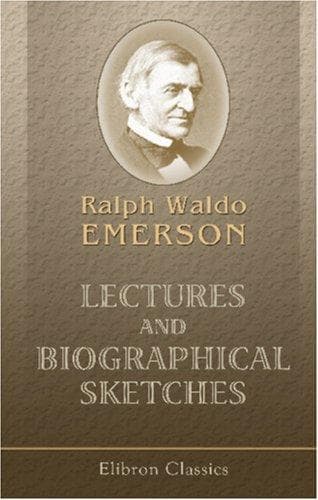
Lectures and biographical sketchesEmerson, Ralph Waldo
Philosophy
Lectures and biographical sketches
Emerson, Ralph Waldo
American essays -- 19th century; Speeches, addresses, etc., American -- 19th century
The subtle Hindoo, who
carried religion to ecstasy and philosophy to idealism, produced the
wonderful epics of which, in the present century, the translations have
added new regions to thought. The Egyptian built Thebes and Karnak on
a scale which dwarfs our art, and by the paintings on their interior
walls invited us into the secret of the religious belief whence he drew
such power. The Greek was so perfect in action and in imagination, his
poems, from Homer to Euripides, so charming in form and so true to
the human mind, that we cannot forget or outgrow their mythology. The
Hebrew nation compensated for the insignificance of its members and
territory by its religious genius, its tenacious belief; its poems and
histories cling to the soil of this globe like the primitive rocks.
On the south and east shores of the Mediterranean Mahomet impressed
his fierce genius how deeply into the manners, language and poetry of
Arabia and Persia! See the activity of the imagination in the Crusades:
the front of morn was full of fiery shapes; the chasm was bridged over;
heaven walked on earth, and Earth could see with eyes the Paradise
and the Inferno. Dramatic “mysteries” were the entertainment of the
people. Parliaments of Love and Poesy served them, instead of the
House of Commons, Congress and the newspapers. In Puritanism, how the
whole Jewish history became flesh and blood in those men, let Bunyan
show. Now it is agreed that we are utilitarian; that we are skeptical,
frivolous; that with universal cheap education we have stringent
theology, but religion is low. There is much criticism, not on deep
grounds, but an affirmative philosophy is wanting. Our profoundest
philosophy (if it were not contradiction in terms) is skepticism.
The great poem of the age is the disagreeable poem of “Faust,”--of
which the “Festus” of Bailey and the “Paracelsus” of Browning are
English variations. We have superficial sciences, restless, gossiping,
aimless activity. We run to Paris, to London, to Rome, to Mesmerism,
Spiritualism, to Pusey, to the Catholic Church, as if for the want of
thought, and those who would check and guide have a dreary feeling
that in the change and decay of the old creeds and motives there was no
offset to supply their place. Our industrial skill, arts ministering to
convenience and luxury, have made life expensive, and therefore greedy,
careful, anxious; have turned the eyes downward to the earth, not
upward to thought.
Ernest Renan finds that Europe has thrice assembled for exhibitions of
industry, and not a poem graced the occasion; and nobody remarked the
defect. A French prophet of our age, Fourier, predicted that one day,
instead of by battles and Œcumenical Councils, the rival portions of
humanity would dispute each other’s excellence in the manufacture of
little cakes.
Public-domain text, read in full here on John Shaqi.
Reviews
Reviews
No reviews yet
Be the first to share your thoughts on this work.
Elsewhere in the archive
Join the Discussion
Join the discussion
Sign in to leave a comment or review.
Sign InorCreate an account