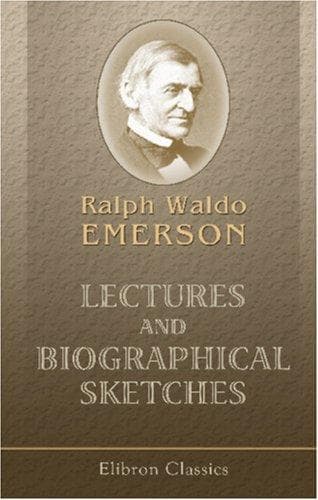
Lectures and biographical sketchesEmerson, Ralph Waldo
Philosophy
Lectures and biographical sketches
Emerson, Ralph Waldo
American essays -- 19th century; Speeches, addresses, etc., American -- 19th century
Later she writes of her early days in Malden: “When I get a glimpse of
the revolutions of nations--that retribution which seems forever going
on in this part of creation,--I remember with great satisfaction that
from all the ills suffered, in childhood and since, from others, I felt
that it was rather the order of things than their individual fault.
It was from being early impressed by my poor unpractical aunt, that
Providence and Prayer were all in all. Poor woman! Could her own temper
in childhood or age have been subdued, how happy for herself, who had
a warm heart; but for me would have prevented those early lessons of
fortitude, which her caprices taught me to practise. Had I prospered in
life, what a proud, excited being, even to feverishness, I might have
been. Loving to shine, flattered and flattering, anxious, and wrapped
in others, frail and feverish as myself.”
She alludes to the early days of her solitude, sixty years afterward,
on her own farm in Maine, speaking sadly the thoughts suggested by the
rich autumn landscape around her: “Ah! as I walked out this afternoon,
so sad was wearied Nature that I felt her whisper to me, ‘Even these
leaves you use to think my better emblems have lost their charm on
me too, and I weary of my pilgrimage,--tired that I must again be
clothed in the grandeurs of winter, and anon be bedizened in flowers
and cascades. Oh, if there be a power superior to me,--and that there
is, my own dread fetters proclaim,--when will He let my lights go
out, my tides cease to an eternal ebb? Oh for transformation! I am
not infinite, nor have I power or will, but bound and imprisoned, the
tool of mind, even of the beings I feed and adorn. Vital, I feel not:
not active, but passive, and cannot aid the creatures which seem my
progeny,--myself. But you are ingrate to tire of me, now you want to
look beyond. ’Twas I who soothed your thorny childhood, though you knew
me not, and you were placed in my most leafless waste. Yet I comforted
thee when going on the daily errand, fed thee with my mallows, on the
first young day of bread failing. More, I led thee when thou knewest
not a syllable of my active Cause, (any more than if it had been dead
eternal matter,) to that Cause; and from the solitary heart taught thee
to say, at first womanhood, Alive with God is enough,--’tis rapture.’”
Public-domain text, read in full here on John Shaqi.
Reviews
Reviews
No reviews yet
Be the first to share your thoughts on this work.
Elsewhere in the archive
Join the Discussion
Join the discussion
Sign in to leave a comment or review.
Sign InorCreate an account