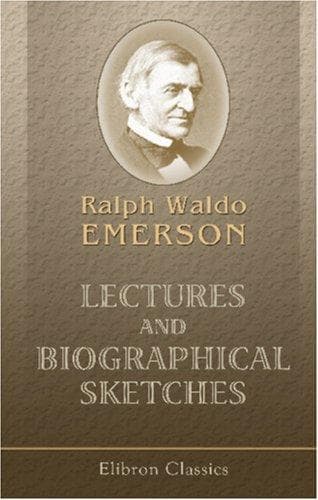
Lectures and biographical sketchesEmerson, Ralph Waldo
Philosophy
Lectures and biographical sketches
Emerson, Ralph Waldo
American essays -- 19th century; Speeches, addresses, etc., American -- 19th century
He was a man in whom so rare a spirit of justice visibly dwelt, that if
one had met him in a cabin or in a forest he must still seem a public
man, answering as sovereign state to sovereign state; and might easily
suggest Milton’s picture of John Bradshaw, that “he was a consul from
whom the fasces did not depart with the year, but in private seemed
ever sitting in judgment on kings.” Everybody knew where to find him.
What he said, that would he do. But he disdained any arts in his
speech: he was not adorned with any graces of rhetoric,
“But simple truth his utmost skill.”
So cautious was he, and tender of the truth, that he sometimes
wearied his audience with the pains he took to qualify and verify
his statements, adding clause on clause to do justice to all his
conviction. He had little or no power of generalization. But a plain
way he had of putting his statement with all his might, and now and
then borrowing the aid of a good story, or a farmer’s phrase, whose
force had imprinted it on his memory, and, by the same token, his
hearers were bound to remember his point.
The impression he made on juries was honorable to him and them. For
a long term of years, he was at the head of the bar in Middlesex,
practising, also, in the adjoining counties. He had one side or the
other of every important case, and his influence was reckoned despotic,
and sometimes complained of as a bar to public justice. Many good
stories are still told of the perplexity of jurors who found the law
and the evidence on one side, and yet Squire Hoar had said that he
believed, on his conscience, his client entitled to a verdict. And what
Middlesex jury, containing any God-fearing men in it, would hazard
an opinion in flat contradiction to what Squire Hoar believed to be
just? He was entitled to this respect; for he discriminated in the
business that was brought to him, and would not argue a rotten cause;
and he refused very large sums offered him to undertake the defense of
criminal persons.
His character made him the conscience of the community in which he
lived. And in many a town it was asked, “What does Squire Hoar think of
this?” and in political crises, he was entreated to write a few lines
to make known to good men in Chelmsford, or Marlborough, or Shirley,
what that opinion was. I used to feel that his conscience was a kind
of meter of the degree of honesty in the country, by which on each
occasion it was tried, and sometimes found wanting. I am sorry to say
he could not be elected to Congress a second time from Middlesex.
Public-domain text, read in full here on John Shaqi.
Reviews
Reviews
No reviews yet
Be the first to share your thoughts on this work.
Elsewhere in the archive
Join the Discussion
Join the discussion
Sign in to leave a comment or review.
Sign InorCreate an account