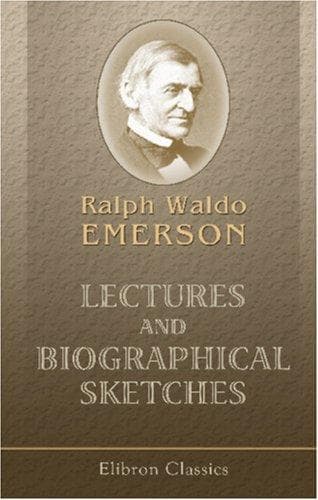
Lectures and biographical sketchesEmerson, Ralph Waldo
Philosophy
Lectures and biographical sketches
Emerson, Ralph Waldo
American essays -- 19th century; Speeches, addresses, etc., American -- 19th century
And in his own town, if some important end was to be gained,--as,
for instance, when the county commissioners refused to rebuild the
burned court-house, on the belief that the courts would be transferred
from Concord to Lowell,--all parties combined to send Mr. Hoar to the
Legislature, where his presence and speech, of course, secured the
rebuilding; and, of course also, having answered our end, we passed him
by and elected somebody else at the next term.
His head, with singular grace in its lines, had a resemblance to the
bust of Dante. He retained to the last the erectness of his tall but
slender form, and not less the full strength of his mind. Such was,
in old age, the beauty of his person and carriage, as if the mind
radiated, and made the same impression of probity on all beholders.
His beauty was pathetic and touching in these latest days, and, as now
appears, it awakened a certain tender fear in all who saw him, that the
costly ornament of our homes and halls and streets was speedily to be
removed. Yet how solitary he looked, day by day in the world, this man
so revered, this man of public life, of large acquaintance and wide
family connection! Was it some reserve of constitution, or was it only
the lot of excellence, that with aims so pure and single, he seemed to
pass out of life alone, and, as it were, unknown to those who were his
contemporaries and familiars?
[The following sketch of Mr. Hoar from a slightly different point of
view, was prepared by Mr. Emerson, shortly after the above speech
appeared in “Putnam’s Magazine” (December, 1856), at the request of
the Editor of the “Monthly Religious Magazine,” and was printed there,
January, 1857. It is here appended as giving some additional traits of
a characteristic figure which may serve as a pendant in some respects
to that of Dr. Ripley.]
Mr. Hoar was distinguished in his profession by the grasp of his
mind, and by the simplicity of his means. His ability lay in the
clear apprehension and the powerful statement of the material points
of his case. He soon possessed it, and he never possessed it better,
and he was equally ready at any moment to state the facts. He saw
what was essential and refuted whatever was not, so that no man
embarrassed himself less with a needless array of books and evidences
of contingent value.
Public-domain text, read in full here on John Shaqi.
Reviews
Reviews
No reviews yet
Be the first to share your thoughts on this work.
Elsewhere in the archive
Join the Discussion
Join the discussion
Sign in to leave a comment or review.
Sign InorCreate an account