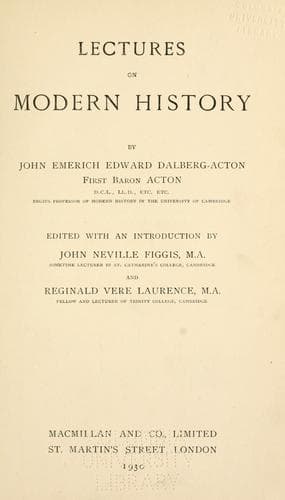
Lectures on Modern historyActon, John Emerich Edward Dalberg Acton, Baron
History
Lectures on Modern history
Acton, John Emerich Edward Dalberg Acton, Baron
History, Modern
E-text prepared by Geoffrey Cowling
LECTURES ON MODERN HISTORY
by
LORD ACTON (JOHN EMERICH EDWARD DALBERG-ACTON)
INAUGURAL LECTURE
ON THE STUDY OF HISTORY
Delivered at Cambridge, June 1895
FELLOW STUDENTS--I look back today to a time before the middle of
the century, when I was reading at Edinburgh and fervently
wishing to come to this University. At three colleges I applied
for admission, and, as things then were, I was refused by all.
Here, from the first, I vainly fixed my hopes, and here, in
a happier hour, after five-and-forty years, they are at last
fulfilled.
I desire, first, to speak to you of that which I may reasonably
call the Unity of Modern History, as an easy approach to questions
necessary to be met on the threshold by any one occupying this
place, which my predecessor has made so formidable to me by the
reflected lustre of his name.
You have often heard it said that Modern History is a subject to
which neither beginning nor end can be assigned. No beginning,
because the dense web of the fortunes of man is woven without a
void; because, in society as in nature, the structure is
continuous, and we can trace things back uninterruptedly, until
we dimly descry the Declaration of Independence in the forests of
Germany. No end, because, on the same principle, history made
and history making are scientifically inseparable and separately
unmeaning.
"Politics," said Sir John Seeley, "are vulgar when they are not
liberalised by history, and history fades into mere literature
when it loses sight of its relation to practical politics."
Everybody perceives the sense in which this is true. For the
science of politics is the one science that is deposited by the
stream of history, like grains of gold in the sand of a river;
and the knowledge of the past, the record of truths revealed by
experience, is eminently practical, as an instrument of action
and a power that goes to the making of the future #1. In France,
such is the weight attached to the study of our own time, that
there is an appointed course of contemporary history, with
appropriate text-books #2. That is a chair which, in the progressive
division of labour by which both science and government prosper #3,
may some day be founded in this country. Meantime, we do well to
acknowledge the points at which the two epochs diverge. For the
contemporary differs from the modern in this, that many of its
facts cannot by us be definitely ascertained. The living do not
give up their secrets with the candour of the dead; one key is
always excepted, and a generation passes before we can ensure
accuracy. Common report and outward seeming are bad copies of the
reality, as the initiated know it. Even of a thing so memorable
as the war of 1870, the true cause is still obscure; much that we
believed has been scattered to the winds in the last six months,
and further revelations by important witnesses are about to
appear. The use of history turns far more on certainty than on
Public-domain text, read in full here on John Shaqi.
Reviews
Reviews
No reviews yet
Be the first to share your thoughts on this work.
Join the Discussion
Join the discussion
Sign in to leave a comment or review.
Sign InorCreate an account