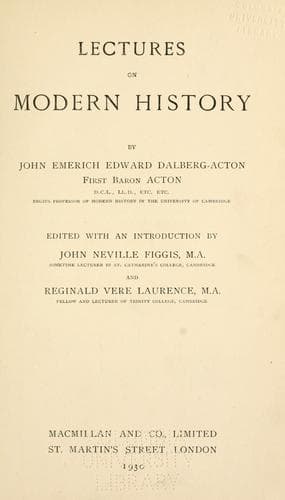
Lectures on Modern historyActon, John Emerich Edward Dalberg Acton, Baron
History
Lectures on Modern history
Acton, John Emerich Edward Dalberg Acton, Baron
History, Modern
abundance of acquired information.
Beyond the question of certainty is the question of detachment.
The process by which principles are discovered and appropriated
is other than that by which, in practice, they are applied; and
our most sacred and disinterested convictions ought to take shape
in the tranquil regions of the air, above the tumult and the
tempest of active life #4. For a man is justly despised who has one
opinion in history and another in politics, one for abroad and
another at home, one for opposition and another for office.
History compels us to fasten on abiding issues, and rescues us
from the temporary and transient. Politics and history are
interwoven, but are not commensurate. Ours is a domain that
reaches farther than affairs of state, and is not subject to the
jurisdiction of governments. It is our function to keep in view
and to command the movement of ideas, which are not the effect
but the cause of public events #5; and even to allow some priority
to ecclesiastical history over civil, since, by reason of the
graver issues concerned, and the vital consequences of error, it
opened the way in research, and was the first to be treated by
close reasoners and scholars of the higher rank #6.
In the same manner, there is wisdom and depth in the philosophy which
always considers the origin and the germ, and glories in history as
one consistent epic #7. Yet every student ought to know that mastery
is acquired by resolved limitation. And confusion ensues from the
theory of Montesquieu and of his school, who, adapting the same term
to things unlike, insist that freedom is the primitive condition of
the race from which we are sprung #8. If we are to account mind not
matter, ideas not force, the spiritual property that gives dignity and
grace and intellectual value to history, and its action on the
ascending life of man, then we shall not be prone to explain the
universal by the national, and civilisation by custom #9. A speech of
Antigone, a single sentence of Socrates, a few lines that were
inscribed on an Indian rock before the Second Punic War, the footsteps
of a silent yet prophetic people who dwelt by the Dead Sea, and
perished in the fall of Jerusalem, come nearer to our lives than the
ancestral wisdom of barbarians who fed their swine on the Hercynian
acorns.
Public-domain text, read in full here on John Shaqi.
Reviews
Reviews
No reviews yet
Be the first to share your thoughts on this work.
Join the Discussion
Join the discussion
Sign in to leave a comment or review.
Sign InorCreate an account