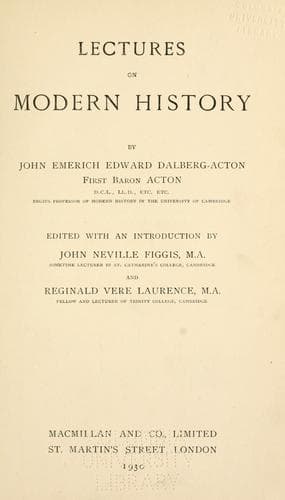
Lectures on Modern historyActon, John Emerich Edward Dalberg Acton, Baron
History
Lectures on Modern history
Acton, John Emerich Edward Dalberg Acton, Baron
History, Modern
When we consider what the adverse forces were, their sustained
resistance, their frequent recovery, the critical moments when
the struggle seemed for ever desperate, in 1685, in 1772, in
1808, it is no hyperbole to say that the progress of the world
towards self-government would have been arrested but for the
strength afforded by the religious motive in the seventeenth
century. And this constancy of progress, of progress in the
direction of organised and assured freedom, is the characteristic
fact of Modern History, and its tribute to the theory of
Providence #35. Many persons, I am well assured, would detect that
this is a very old story, and a trivial commonplace, and would
challenge proof that the world is making progress in aught but
intellect, that it is gaining in freedom, or that increase in
freedom is either a progress or a gain. Ranke, who was my own
master, rejected the view that I have stated #36; Comte, the master
of better men, believed that we drag a lengthening chain under
the gathered weight of the dead hand #37; and many of our recent
classics--Carlyle, Newman, Froude--were persuaded that there is
no progress justifying the ways of God to man, and that the mere
consolidation of liberty is like the motion of creatures whose
advance is in the direction of their tails. They deem that
anxious precaution against bad government is an obstruction to
good, and degrades morality and mind by placing the capable at
the mercy of the incapable, dethroning enlightened virtue for the
benefit of the average man. They hold that great and salutary
things are done for mankind by power concentrated, not by power
balanced and cancelled and dispersed, and that the whig theory,
sprung from decomposing sects, the theory that authority is
legitimate only by virtue of its checks, and that the sovereign
is dependent on the subject, is rebellion against the divine will
manifested all down the stream of time.
Public-domain text, read in full here on John Shaqi.
Reviews
Reviews
No reviews yet
Be the first to share your thoughts on this work.
Join the Discussion
Join the discussion
Sign in to leave a comment or review.
Sign InorCreate an account