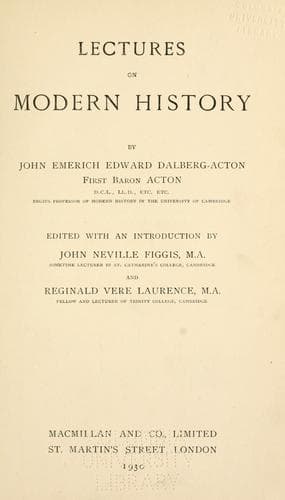
Lectures on Modern historyActon, John Emerich Edward Dalberg Acton, Baron
History
Lectures on Modern history
Acton, John Emerich Edward Dalberg Acton, Baron
History, Modern
Out of these controversies proceeded political as well as
historical science. It was in the Puritan phase, before the
restoration of the Stuarts, that theology, blending with
politics, effected a fundamental change. The essentially English
reformation of the seventeenth century was less a struggle
between churches than between sects, often subdivided by
questions of discipline and self-regulation rather than by dogma.
The sectaries cherished no purpose or prospect of prevailing over
the nations; and they were concerned with the individual more
than with the congregation, with conventicles, not with State
churches. Their view was narrowed, but their sight was
sharpened. It appeared to them that governments and institutions
are made to pass away, like things of earth, whilst souls are
immortal; that there is no more proportion between liberty and
power than between eternity and time; that, therefore, the sphere
of enforced command ought to be restricted within fixed limits,
and that which had been done by authority, and outward discipline,
and organised violence, should be attempted by division of power,
and committed to the intellect and the conscience of free men #32.
Thus was exchanged the dominion of will over will for the dominion
of reason over reason. The true apostles of toleration are not
those who sought protection for their own beliefs, or who had none
to protect; but men to whom, irrespective of their cause, it was
a political, a moral, and a theological dogma, a question of
conscience involving both religion and policy #33. Such a man was
Socinus; and others arose in the smaller sects--the Independent
founder of the colony of Rhode Island, and the Quaker patriarch
of Pennsylvania. Much of the energy and zeal which had laboured
for authority of doctrine was employed for liberty of prophesying.
The air was filled with the enthusiasm of a new cry; but the cause
was still the same. It became a boast that religion was the
mother of freedom, that freedom was the lawful offspring of religion;
and this transmutation, this subversion of established forms of
political life by the development of religious thought, brings us
to the heart of my subject, to the significant and central feature of
the historic cycles before us. Beginning with the strongest
religious movement and the most refined despotism ever known, it
has led to the superiority of politics over divinity in the life
of nations, and terminates in the equal claim of every man to be
unhindered by man in the fulfilment of duty to God #34--a doctrine
laden with storm and havoc, which is the secret essence of the
Rights of Man, and the indestructible soul of Revolution.
Public-domain text, read in full here on John Shaqi.
Reviews
Reviews
No reviews yet
Be the first to share your thoughts on this work.
Join the Discussion
Join the discussion
Sign in to leave a comment or review.
Sign InorCreate an account