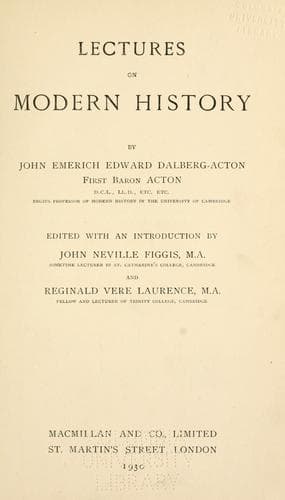
Lectures on Modern historyActon, John Emerich Edward Dalberg Acton, Baron
History
Lectures on Modern history
Acton, John Emerich Edward Dalberg Acton, Baron
History, Modern
Very early in the first or Latin phase of the revival, people
suspected that familiarity with the classics would lead to admiration
for paganism. Coluccio Salutato, who had been Florentine Secretary
from the time of Petrarca, and is a classical writer of Latin letters,
had to defend the new learning against the rising reproach of
irreligion; and the statue of Virgil was ignominiously removed from
the market-place of the town which his birth has made illustrious, as
a scandal to good men. Petrarca never became a Greek scholar. He
felt the defect. To write beautiful Latin was nothing, unless there
was more to say than men already knew. But the Latin classics were no
new discovery. The material increase of knowledge was quite
insufficient to complete the type of an accomplished man. The great
reservoir of ideas, of forgotten sciences, of neglected truth,
remained behind. Without that, men would continue to work at a
disadvantage, to fight in the dark, and could never fulfil the
possibilities of existence. What was impatiently felt as the medieval
eclipse came not from the loss of elegant Latin, but from the loss of
Greek. All that was implied in the intended resurrection of antiquity
depended on the revival of Greek studies. Because Petrarca possessed
the culture of his time beyond all men, he was before them all in
feeling what it needed most. Knowledge of truth, not casual and
partial, but as complete and certain as the remaining civilisation
admitted, would have to be abandoned, if Latin was still to be the
instrument and the limit. Then the new learning would not be strong
enough to break down the reliance on approved authors, the tyranny of
great names, the exclusiveness of schools. Neither rhetoric nor
poetry could deprive Aristotle and Peter Lombard, St. Augustine and
St. Thomas, of their supremacy, give them their position in the
incessant stream of thought, or reduce them beneath the law of
progress in the realm of knowledge.
The movement which Petrarca initiated implied the revival of a buried
world, the enrichment of society by the mass of things which the
western nations had allowed to drop, and of which medieval
civilisation was deprived. It meant the preference for Grecian
models, the supremacy of the schools of Athens, the inclusion of
science in literature, the elevation of Hippocrates and Archimedes to
a level with Terence and Quintilian, the reproduction of that Hellenic
culture which fought the giant fight of the fourth and fifth century
with the Councils and Fathers of the Church. That is why the Latin
restoration, which was the direct result of Petrarca's example, was
overwhelmed by the mightier change that followed, when a more perfect
instrument reached the hands of men passionately curious and yearning
for new things.
Public-domain text, read in full here on John Shaqi.
Reviews
Reviews
No reviews yet
Be the first to share your thoughts on this work.
Elsewhere in the archive
Join the Discussion
Join the discussion
Sign in to leave a comment or review.
Sign InorCreate an account