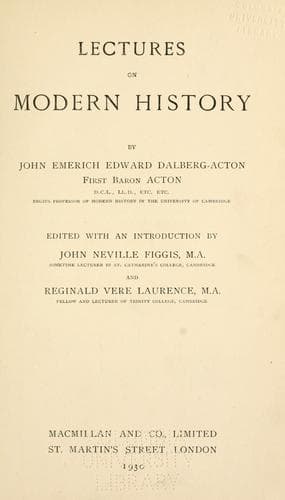
Lectures on Modern historyActon, John Emerich Edward Dalberg Acton, Baron
History
Lectures on Modern history
Acton, John Emerich Edward Dalberg Acton, Baron
History, Modern
At first there was no way of acquiring the unknown tongue. But the
second generation of Humanists sat at the feet of Byzantine masters.
The first was Chrysoloras, who was sent to Italy on a political
mission and settled in 1397 as a teacher of his own language at
Florence. When he died, at the council of Constance, there were
Italian scholars who could read Greek MSS. As teachers were scarce,
adventurous men, such as Scarparia, Guarino, Aurispa, pursued their
studies at Constantinople. Filelfo remained there for seven years,
working in great libraries not yet profaned by the Turk. Before the
middle of the fifteenth century Italy was peopled with migratory
scholars, generally poor, and without fixed appointments, but able to
rouse enthusiasm when they offered Plato for Henry of Ghent, and
Thucydides for Vincent of Beauvais. By that time the superiority of
the new learning, even in its very fragmentary condition, was
irresistible.
Just then three events occurred which determined the triumph of the
Renaissance. The Emperor came over to the Council of Florence with a
number of bishops and divines. In the discussions that followed,
Greek scholars were in demand; and one Eastern prelate, Bessarion,
remained in Italy, became a cardinal, and did much for the study of
Plato and the termination of the long Aristotelian reign. His fine
collection of manuscripts was at the service of scholars, and is still
at their service, in St. Mark's library at Venice. The fall of
Constantinople drove several fugitives to seek a refuge in Italy, and
some brought their books with them, which were more scarce and more
needful than men. For by that time Greek studies were well
established, and suffered only from the extreme scarcity of
manuscripts. The third important event was the election of
Parentucelli, who became Pope Nicholas V. On that day the new
learning took possession of the Holy See, and Rome began to be
considered the capital of the Renaissance.
Public-domain text, read in full here on John Shaqi.
Reviews
Reviews
No reviews yet
Be the first to share your thoughts on this work.
Elsewhere in the archive
Join the Discussion
Join the discussion
Sign in to leave a comment or review.
Sign InorCreate an account