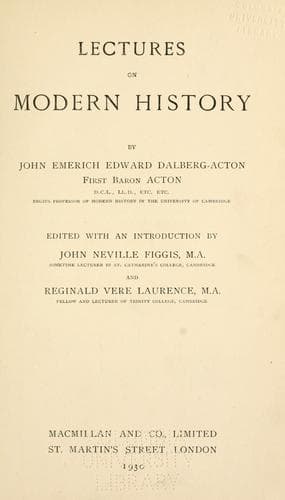
Lectures on Modern historyActon, John Emerich Edward Dalberg Acton, Baron
History
Lectures on Modern history
Acton, John Emerich Edward Dalberg Acton, Baron
History, Modern
It was not in the nature of things that this should be. For the new
men, with their new instrument of intellectual power, invaded
territory which was occupied by the clergy. In the Middle Ages the
Church, that is to say, first the cloister, then the universities
founded under the protectorate of the Church, had the civilising of
society, and, apart from law, the monopoly of literature. That came
to an end when the clergy lost the superiority of knowledge, and had
to share their influence with profane laymen, trained in the classics,
and more familiar with pagan than with Christian writers. There was a
common presumption in favour of the new point of view, the larger
horizon, of opinions that were founded on classical as well as on
Christian material. The Humanists had an independent judgment and
could contemplate the world they lived in from outside, without
quitting it, standing apart from the customary ways. As Pater said:
"The human mind wins for itself a new kingdom of feeling and sensation
and thought, not opposed to, but only beyond and independent of the
spiritual system then actually realised."
This is one of many causes operating at the time to weaken the notion
of ecclesiastical control. It was the triumphant return of an exile,
with an uproarious popularity and a claim to compensation for arrears.
The enthusiasm of those who were the first to read Homer, and
Sophocles, and Plato grew into complaint against those by whose neglect
such treasures had been lost. Centuries of ignorance and barbarism
had been the consequence. There was not only a world of new ideas,
but of ideas that were not Christian, which the Christianity of the
West had discarded. They began to recover the lost power, and the
ages in which they had been unknown became the ages of darkness. As
they were also ages in which the Church had exerted supreme authority,
antagonism was not to be averted. The endeavour was not only to make
the range of men's thought more comprehensive, but to enrich it with
the rejected wisdom of paganism. Religion occupied a narrower space
in the new views of life than in those of Dante and the preceding
time. The sense of sinfulness was weaker among the Humanists, the
standard of virtue was lower; and this was common to the most
brilliant of the Italian prelates, such as Aeneas Sylvius, with the
king of the Renaissance, Erasmus himself.
Public-domain text, read in full here on John Shaqi.
Reviews
Reviews
No reviews yet
Be the first to share your thoughts on this work.
Elsewhere in the archive
Join the Discussion
Join the discussion
Sign in to leave a comment or review.
Sign InorCreate an account