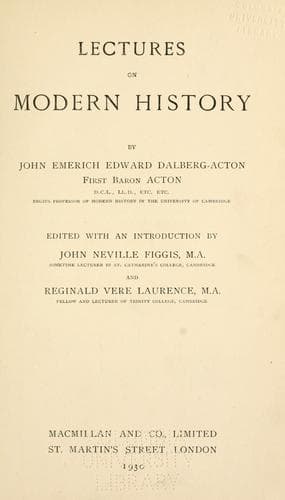
Lectures on Modern historyActon, John Emerich Edward Dalberg Acton, Baron
History
Lectures on Modern history
Acton, John Emerich Edward Dalberg Acton, Baron
History, Modern
Lorenzo Valla, the strongest of the Italian Humanists, is also the one
who best exhibits the magnitude of the change that was going on in the
minds of men. He had learnt to be a critic, and, what was more rare,
a historical critic. He wrote against the belief in the writings of
Dionysius the Areopagite, which was one of the fixed positions of
theology, then and long after. When the Greeks at the Council of
Florence declared themselves unacquainted with the Apostles' Creed,
Valla warned the Latins not to speak of it as an apostolic
composition. During a war between Rome and Naples, Valla, in the
Neapolitan service, attacked the Donation of Constantine as the basis
of the temporal power, and exhorted Pope Eugenius to abandon what was
a usurpation, and a usurpation founded on fraud. Formidable in all
the armour of the new learning, he did more than any other man to
spread the conviction that the favourite arguments of the clergy were
destined to go down before the better opinion of profane scholars.
Valla is also the link between Italy and Germany. His critical essay
on the New Testament in the Vulgate influenced Erasmus, who published
it in 1505. His tract against the Donation, as the title-deed of the
temporal sovereignty, was printed by Ulrich von Hutten, and spread
that belief that the Pope was an antichrist, which was afterwards an
important article of the Huguenot Church. He was also a forerunner of
the Reformation by his tract on the Freedom of the Will. This man,
who displayed so conspicuously the resentful and iconoclastic spirit,
the religious scepticism, the moral indifference, the aversion for the
papal sovereignty, the contempt for the laws and politics of
feudalism, the hope and expectation of a mighty change, was an
official in the Pope's household.
After the discussion with the Greeks at Florence it was clear to all
men that there was a deeper issue than the revival of classical
learning, that there was a Christian as well as a pagan antiquity, and
that the knowledge of the early Church depended on Greek writings, and
was as essential a part of the Renaissance as the study of Homer or of
Pindar. The inference was drawn by Nicholas V, the first Renaissance
pontiff. He recognised the fact that a divine in full possession of
Hellenic literature would be a more competent defender of tradition, a
better writer, a stronger disputant, than the long line of scholastic
teachers. He saw that it would be the means of renovating theology
and disclosing the authentic and necessary evidences of historical
religion. The most enlightened ecclesiastics of that age understood
but vaguely that there was not only benefit and enrichment in a policy
that favoured the new learning, but the only possible escape from a
serious danger.
Public-domain text, read in full here on John Shaqi.
Reviews
Reviews
No reviews yet
Be the first to share your thoughts on this work.
Elsewhere in the archive
Join the Discussion
Join the discussion
Sign in to leave a comment or review.
Sign InorCreate an account