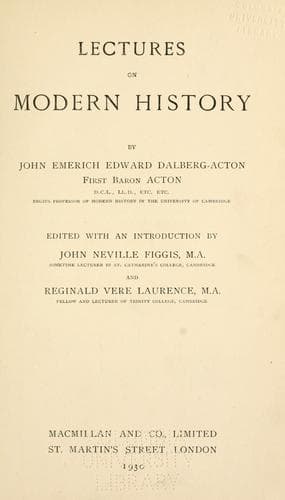
Lectures on Modern historyActon, John Emerich Edward Dalberg Acton, Baron
History
Lectures on Modern history
Acton, John Emerich Edward Dalberg Acton, Baron
History, Modern
Religious knowledge in those days suffered not only from ignorance and
the defect of testimony, but from an excess of fiction and
falsification. Whenever a school was lacking in proofs for its
opinions, it straightway forged them, and was sure not to be found
out. A vast mass of literature arose, which no man, with medieval
implements, could detect, and effectually baffled and deceived the
student of tradition. At every point he was confronted by imaginary
canons and constitutions of the apostles, acts of Councils, decretals
of early Popes, writings of the Fathers from St. Clement to St. Cyril,
all of them composed for the purpose of deceiving.
The example of Lorenzo Valla made it certain that all this was about
to be exposed. The process that began with him lasted for two
centuries, to the patriarchs of authentic erudition, Ussher and
Pearson, Blondel and Launoy, the Bollandists of Antwerp and the
Benedictines of Saint-Maur. It became apparent that the divines of
many ages had been remarkable for their incapacity to find out
falsehood, and for their dexterity in propagating it, and it made no
little difference whether this tremendous exposure should be made by
enemies, and should constitute one series of disasters for religion.
This was prevented by the resolve of Pope Nicholas, that the Holy See
should sanction and encourage the movement with its influence, its
immense patronage, and all its opportunities. Therefore Valla, who
had narrowly escaped alive from the Inquisition, became a functionary
at the Vatican, and received 500 ducats from the Pope to translate
Thucydides. Scholars were attracted by the papal collection of 5000
manuscripts, which were the foundation of the Vatican library, the
first in the world after the fall of Constantinople.
Public-domain text, read in full here on John Shaqi.
Reviews
Reviews
No reviews yet
Be the first to share your thoughts on this work.
Elsewhere in the archive
Join the Discussion
Join the discussion
Sign in to leave a comment or review.
Sign InorCreate an account