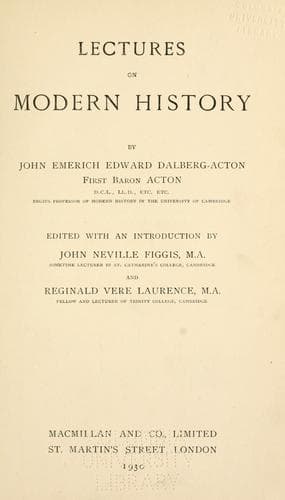
Lectures on Modern historyActon, John Emerich Edward Dalberg Acton, Baron
History
Lectures on Modern history
Acton, John Emerich Edward Dalberg Acton, Baron
History, Modern
Here we reach a point at which my argument threatens to abut on a
contradiction. If the supreme conquests of society are won more often
by violence than by lenient arts, if the trend and drift of things is
towards convulsions and catastrophes #52, if the world owes religious
liberty to the Dutch Revolution, constitutional government to the
English, federal republicanism to the American, political equality to
the French and its successors #53, what is to become of us, docile and
attentive students of the absorbing Past? The triumph of the
Revolutionist annuls the historian #54. By its authentic exponents,
Jefferson and Sieyes, the Revolution of the last century repudiates
history. Their followers renounced acquaintance with it, and were
ready to destroy its records and to abolish its inoffensive
professors. But the unexpected truth, stranger than fiction, is that
this was not the ruin but the renovation of history. Directly and
indirectly, by process of development and by process of reaction, an
impulse was given which made it infinitely more effectual as a factor
of civilisation than ever before, and a movement began in the world of
minds which was deeper and more serious than the revival of ancient
learning #55. The dispensation under which we live and labour consists
first in the recoil from the negative spirit that rejected the law of
growth, and partly in the endeavour to classify and adjust the
Revolution, and to account for it by the natural working of historic
causes. The Conservative line of writers, under the name of the
Romantic or Historical School, had its seat in Germany, looked upon
the Revolution as an alien episode, the error of an age, a disease to
be treated by the investigation of its origin, and strove to unite the
broken threads and to restore the normal conditions of organic
evolution. The Liberal School, whose home was France, explained and
justified the Revolution as a true development, and the ripened fruit
of all history #56. These are the two main arguments of the generation to
which we owe the notion and the scientific methods that make history
so unlike what it was to the survivors of the last century.
Severally, the innovators were not superior to the men of old.
Muratori was as widely read, Tillemont as accurate, Liebnitz as able,
Freret as acute, Gibbon as masterly in the craft of composite
construction. Nevertheless, in the second quarter of this century, a
new era began for historians.
Public-domain text, read in full here on John Shaqi.
Reviews
Reviews
No reviews yet
Be the first to share your thoughts on this work.
Join the Discussion
Join the discussion
Sign in to leave a comment or review.
Sign InorCreate an account